
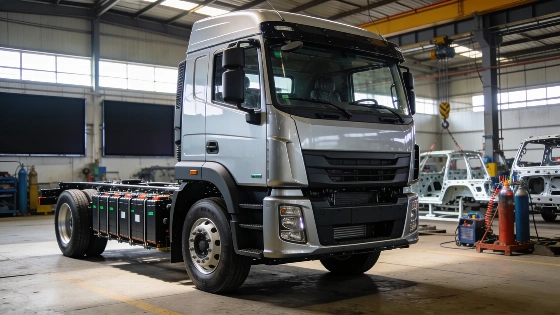
The truck's battery stores 600 kilowatt-hours of energy and its motor delivers 375kW. The flagship configuration is a 6×4 electric tractor head with reinforced suspension. At its unveiling at Dangote Sinotruk West Africa Limited's Ikeja facility on 15 November 2026, Dangote Group and Chinese manufacturer Sinotruk described the vehicle as Nigeria's first locally assembled electric heavy-duty truck; some coverage also called it Africa's first. Daily Times Nigeria reported the vehicle's configuration and specifications.
It has a stated driving range of 350 kilometres, which the companies said makes it suitable for commercial transport. The unveiling adds a battery-electric model to a commercial vehicle partnership that has expanded from conventional diesel and compressed-natural-gas vehicles into more extensive local manufacturing. The company said it was preparing charging support and spare-parts availability, along with technical training for customers.
A partnership built through local assembly
Sinotruk Group President Liu Wei said the partnership with Dangote began in 2010 and became a joint venture in 2014. Its first heavy-duty truck came off the assembly line in 2017. A commercial-vehicle welding and e-coating paint line began operating in 2024, according to Wei. THEWILL reported that the joint venture had assembled more than 8,000 vehicles locally over the previous decade, a figure attributed to Liu.
The company's planned product range covers heavy-duty and light trucks, as well as pickups, trailers and vehicle body-building. The electric truck broadens a portfolio that has grown alongside the venture's local assembly operations.
Dangote Industries Limited Group Managing Director Devakumar Edwin said the company had expanded from heavy-duty trucks and tippers into light trucks, pickups and buses. It later entered compressed natural gas-powered vehicles and has now added electric vehicles.
Edwin framed the move as part of the company's effort to keep pace with changes in the global automotive industry. He said electric commercial vehicles could help operators lower running costs and emissions. On the technology behind the vehicle, he said: "And as you know, globally today, the Chinese technology for electric vehicles is number one. They have overtaken Germany; they have overtaken the United States. So, we are bringing in the best of the technology, which will also be highly protective of the Nigerian environment."
The company has described the electric truck as part of its move into new-energy mobility, with plans for charging support and spare parts, plus technical training.
Chinese firms deepen their industrial footprint
The vehicle is part of a wider Chinese commercial presence in Nigeria, spanning construction and manufacturing, alongside transport, telecommunications and energy. Chinese contractors have worked on rail and road projects, while manufacturers have established activity in industrial parks and production facilities. The extent of local value added varies across businesses and sectors.
China Civil Engineering Construction Corporation (CCECC) has worked on major transport and public infrastructure projects. Its portfolio includes the 163-kilometre Lagos-Ibadan standard gauge railway and the 186-kilometre Abuja-Kaduna Railway. The company has also been involved in the Ajaokuta-Itakpe-Warri Railway, the Abuja Metro/Light Rail and Lagos Rail Mass Transit's Blue Line and Red Line.
Other Chinese engineering firms have taken on projects in ports and power. China Harbour Engineering Company (CHEC/CCCC) built the Lekki Deep Sea Port, while China Gezhouba Group Corporation (CGGC) is associated with the Mambilla Hydropower Project. Sinoma International Engineering has built or expanded cement production lines at sites across Nigeria.
Companies including Huawei and ZTE have supplied telecommunications equipment and infrastructure. Chinese suppliers also have a significant presence in solar panels and batteries, as well as related equipment, amid demand from households, businesses and public rural electrification programmes.
For manufacturers, Nigeria offers a large domestic market and the potential to serve other African markets. Industrialist Chief Toba Arilewo said regional trade integration under the African Continental Free Trade Area could strengthen that opportunity. The commercial case for Nigerian infrastructure has also featured in coverage of export reforms.
Public affairs analyst George Nwachukwu said Chinese investment could contribute equipment and construction expertise, along with financing arrangements for projects addressing infrastructure gaps. He also argued that the value of such partnerships depends on building domestic production capabilities and local supply chains, while developing skilled labour and research and development.
"And for Beijing, Nigeria represents a strategic market with enormous population, consumption, natural resources and infrastructure needs," Nwachukwu said.








