
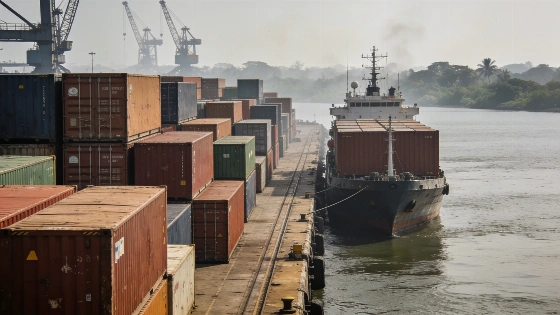
Nigeria's ports handled 68.2 million tonnes of cargo and 815,236 twenty-foot equivalent units (TEUs) of containers in the first half of 2026. Yet the country ranked 45th in global liner connectivity, behind smaller regional competitors, Real News Magazine reported.
Prof. Bongo Adi pointed to that gap at the 17th Lecture and Annual General Meeting of the Nigerian Maritime Law Association (NMLA) in Lagos. He said delays and legal uncertainty were pricing Nigeria out of its own waters, while investment risks discouraged maritime investment.
Cargo clearance is the immediate bottleneck.
Clearance time and legal risk
Adi called for cargo clearance to fall from the 21-day target he cited to seven days. He said shipping companies and insurers assessed Nigeria by its turnaround times and investment risks. Lenders also consider whether legal agreements can be enforced. In a separate November 2026 presentation, maritime lawyer Emeka Akabogu put Lagos cargo dwell time at about 13 days and identified seven days by the end of 2027 as an interim reduction objective, to be pursued through coordinated inspections and faster documentation, with regulatory agencies working more closely.
He argued that quay infrastructure was no longer the weakest link. Apapa and Tin Can had improved vessel turnaround times, as had Onne, compared with ports in Lome and Tema; he also cited Abidjan. Adi used Prof. Michael Kremer's O-ring theory of economic development to explain that the weakest part of an interconnected system can determine its overall performance. Akabogu's separate assessment of seven Nigerian ports put average vessel turnaround at 5.3 days in the first half of 2026, up from five days in the same period of 2025; five ports recorded slower turnaround, while Rivers and Onne improved. He cited about 3.3 days as a competitive benchmark.
Akabogu also reported that container traffic rose year by year, from approximately 1.6 million TEUs in 2023 to 1.75 million in 2024 and 2.1 million in 2025. Total cargo throughput was about 130 million metric tonnes in 2025, with a projection of about 230 million tonnes by 2030 if the growth trend continued. Around 90% of cargo movement from Nigerian ports depended on roads, according to The Eyewitness News.
Similar concerns about the cost of port-related delays have been raised by Nigerian cocoa exporters in a report on exporter costs.
Financing depends on enforceable cash flows
Adi proposed that the NMLA introduce an annual Maritime Justice and Competitiveness Scorecard from November 2027, supported by a reliable official data system. He urged stakeholders to direct funding towards the weakest links in the maritime value chain.
NMLA President Mr Mike Igbokwe, SAN, said Nigeria had an adequate legal framework to protect maritime lenders, particularly through the Admiralty Jurisdiction Act. The Act provides for specified maritime claims, including ship-mortgage claims. In practice, delays in enforcement and prolonged court proceedings remained problems. Statutory priorities also placed mortgage holders at a disadvantage. Company authority and registration of charges, along with insolvency matters, are also governed by the Companies and Allied Matters Act 2020; vessel arrest is subject to applicable procedural and jurisdictional requirements and is not automatic upon default.
At a panel titled "Bankability of the Nigerian Maritime Industry and What Lenders Really Want", maritime lawyer Mr Ogochukwu Eze said the discussion should focus on what would enable lenders to provide capital while protecting cash flows and enforcing security. Maritime lawyer Mr Chibueze Moubuikwu said lenders first examined a vessel's intended use and employment contract. They also assessed whether cash flows could support loan repayment, alongside the borrower's credibility and the enforceability of ship mortgages.
Sterling Bank Plc's Division Head, Institutional Banking Group, Ms Moyomade Akinsoye, said lenders assessed sponsors' credibility and operators' track records. Decisions also reflected contract terms and counterparties. Vessel age and nationality mattered too, as did insurance arrangements. She said maritime financing was possible, though long-term lending required patient capital.
Ms Ogonnaya Emele, legal counsel at Tere Maritime Ltd., said shipowners needed to show that vessel revenue could cover operating costs while servicing loans and leave a profit. She identified market research and charter commitments as important to bankable projects, alongside technical capacity and predictable cash flows.
Financial expert and lawyer Ms Yewande Sebore said bankability depended on legal certainty and clear financing agreements. She pointed to due diligence and sponsor assessments as part of lawyers' contribution, as well as contract reviews and checks on assignment rights and possible barriers to cash flows.
Retired Nigerian Navy Admiral Mr Niyi Labinjo said maritime financing covered vessel acquisition and operating needs, including working capital and maintenance. He advocated blended financing that brought together commercial banks and development finance institutions, with government intervention to support concessional lending rates.








