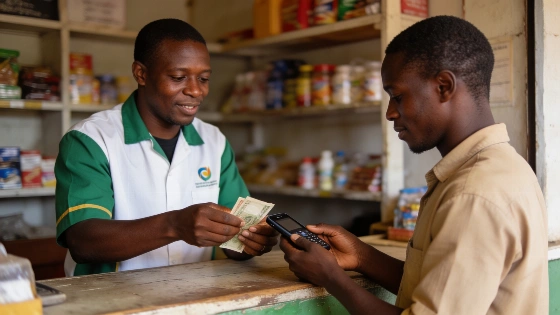
Step into any Tanzanian town and the odds are high that the nearest financial lifeline is a mobile money agent, not a bank. These agents—usually shopkeepers or kiosk owners—anchor the country’s digital economy, handling the bulk of cash and e-money exchanges that keep commerce moving.
Mixx by Yas reported over 20 million users and a monthly transaction volume of about 6 trillion Tanzanian shillings in 2025, supported by a network of more than 200,000 agents.
Agents eclipse banks as the financial frontline
For most people in Tanzania, the closest way to move money isn’t a bank branch. Out of 2.27 million financial access points counted nationwide at the end of 2025, almost 2 million were mobile money agents. Banks and ATMs now play a secondary role, especially outside Dar es Salaam and other big cities. The telecoms regulator put mobile money subscriptions at 87 million by June 2026—well above the country’s population of about 70 million. That figure shows just how deeply these services have taken root.
“People don't think of an agent as financial infrastructure, but that's exactly what it is,” said Ivo Bozukov, a payments industry executive who has tracked the sector’s growth across East Africa. “Every one of those shops is a point where cash meets the digital economy. Without that link, mobile money is just a balance on a screen that nobody can turn back into cash when they need it.”
The Bank of Tanzania reported 7.96 billion mobile payment transactions in 2025, worth TZS 255 trillion. These aren’t just numbers on a spreadsheet. They reflect the daily reality for Tanzanians who depend on agents to swap cash for e-money and back again, often in places where banks never set up shop. According to Daily News (Tanzania), the surge in mobile money has brought a spike in fraud, with 7,334 attempts logged in a single quarter. That’s forced regulators and providers to tighten oversight and push for stronger customer protection.
Regulation and operational realities
Regulators in Tanzania have kept agents open to all providers. Mobile money companies can’t lock agents into exclusive deals, so a single shop can serve customers from different services. That flexibility makes it easier for users to access their money. Still, agents only handle cash-in and cash-out. Transfers and other transactions stay with the mobile money platforms and payment systems.
In the 2025/26 financial year, Tanzania's communications regulator blocked 39,117 phone numbers linked to fraud, restricted access to 6,118 illegal domains and apps, and removed 7,311 non-compliant social media accounts as part of intensified efforts to combat cybercrime in the mobile money sector.
The unglamorous engine of digital finance
To outsiders, a mobile money agent’s kiosk might look like any other corner shop. For millions in Tanzania, it’s the spot where digital balances turn into real cash, and where financial inclusion becomes tangible. The rapid spread of agents has changed the country’s financial map, bringing digital payments to places banks never reached.
This model of financial inclusion runs on the reliability of local shops and regulatory choices that keep the network open. As Tanzania’s digital economy grows, the agent remains the vital link—each cash-to-digital transaction building the system from the ground up.