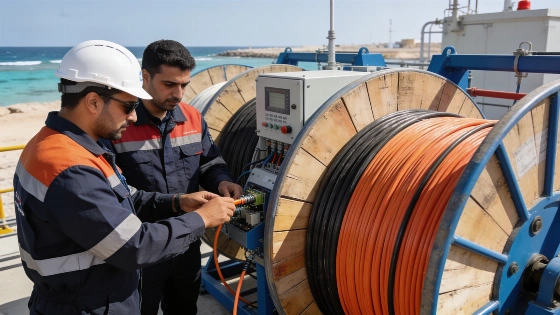
Mobily is moving ahead with the Mobily Red Sea Cable, a new subsea line set to deliver about 140 Tbps of capacity between Saudi Arabia and Egypt. The cable will run from Duba in Saudi Arabia to Sharm El Sheikh in Egypt. This gives telecom operators, hyperscalers, and content providers another route toward Europe. The Red Sea corridor is becoming more important as Saudi Arabia pours money into cloud, AI, data centers, and digital infrastructure.
At the time of the project announcement, Mobily listed four submarine gateways on Saudi Arabia’s coasts: Jeddah (connected to AAE-1, TGN-EA, SEACOM), Al Khobar (TGN-Gulf), Yanbu (SEA-ME-WE 6), and Duba (Africa-1, landed in 2025).
Mobily already runs four submarine gateways on Saudi Arabia’s Red Sea and Gulf coasts. These connect to international systems like AAE-1, TGN-EA, SEACOM, and TGN-Gulf. The new cable will add more international capacity. Saudi Arabia wants to grow its digital links as demand for cloud and AI services rises. Mobily is also investing in more subsea cables, data centers, fiber networks, and cloud and AI partnerships. The company is betting big on digital infrastructure.
Industry analysts say the new route matters. Existing Red Sea cables have known weak spots. Reports show outages and risks to submarine cables in the area. Physically separate routes for international data are now seen as essential. A Light Reading report details how past Red Sea disruptions exposed global connectivity gaps. New, independent routes are now a top priority.
Independent reports describe the Mobily Red Sea Cable as a planned system, with no confirmation yet available regarding commercial launch, construction dates, contractor selection, or activation of the stated 140 Tbps capacity.
In the UK, the MOSAIC-5G group has started a £4.3 million program to speed up commercial use of UK-built 5G tech. The project brings together Aerix, Antevia Networks, Spry Fox Networks, Noema Signal Labs, AttoCore, RANsemi, Liverpool 5G, and Bath & North East Somerset Council. They will combine Antevia’s 5G SHIFT private network, AttoCore’s 5G core, and Aerix’s management platform into a single 5G Standalone private network. The goal is to deploy in hours, not weeks. Noema Signal Labs aims for over 100% gains in spectral efficiency and support for more than 300% extra connected devices at the same service quality. The project has over £3.1 million in Innovate UK funding. It will run from August 2026 to January 2028. Trials are set for Bath and London. Eight high-skilled jobs will be created.
Strategic implications for digital infrastructure
These moves show how operators and tech groups are reacting to the surge in demand for bandwidth and private networks. If Mobily’s Red Sea cable goes ahead as planned, Saudi Arabia will get stronger digital links abroad. The Red Sea will become even more important for data moving between the Middle East, Africa, and Europe. Bluebird Fiber’s upgrade and the MOSAIC-5G project in the UK both show a clear push to scale up and speed up advanced private networks. The winners will be those who can deliver big, reliable infrastructure and fast next-gen connections. That’s what is driving investment and tech choices now.