
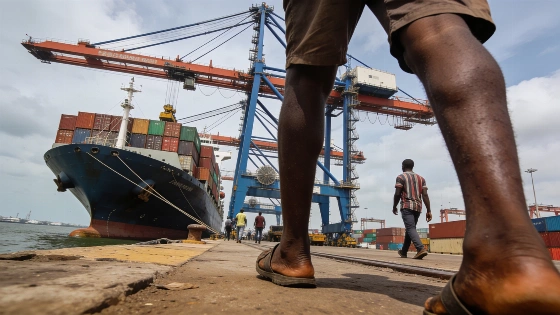
Nigerian ports handled about 2.1 million TEU and 129.3 million tonnes of cargo in 2025, information from Nigerian Ports Authority figures reported by BusinessDay. Lagos remains the centre of the country’s maritime trade, with Apapa and Tin Can Island handling large cargo volumes. Lekki is also a major port.
At the 2026 World Maritime Day celebration in Lagos on 16 October, Minister of Marine and Blue Economy Adegboyega Oyetola reaffirmed the government’s commitment to maritime infrastructure outside Lagos. Onne and Warri are priorities for modernisation, alongside Calabar. The stated goals are to ease congestion at Lagos ports and lower logistics costs. The government says more than 70% of cargo destined for locations outside Lagos still moves through the city’s ports. In March 2026, Nigeria agreed to £746 million in financing supported by UK Export Finance to rehabilitate Apapa and Tin Can Island.
The government has identified six proposed deep seaports. Ibom is proposed for Akwa Ibom State, while Bakassi is planned for Cross River. Agge is proposed for Bayelsa, and Gateway is planned for Ogun State. The other proposed sites are Ondo and Bonny in Rivers State. These remain proposals: financing and construction must advance, with supporting infrastructure in place, before their full economic impact can be realised. By contrast, Lekki Deep Sea Port was commissioned in January 2023 and is operating. It is described as Nigeria’s largest and deepest seaport, with investment associated with the project estimated at more than $20 billion. Oyetola outlined the government’s port priorities.
Transport links will shape the commercial case
More port options could bring goods closer to inland production and consumption centres for importers and exporters. Oyetola said the strategy would connect maritime gateways with inland dry ports and production centres. Roads and railways are part of the plan. Waterways are also intended to support cargo movement and non-oil exports.
A port’s performance alone will not determine whether businesses use a new location. Road and rail links affect the time and cost of moving goods. Cargo-handling capacity and efficient customs processes also matter, alongside port operations. The government’s modernisation programme covers Apapa and Tin Can Island, as well as Rivers and Delta ports.
Onitsha and Baro are among the inland ports that could connect production centres with distribution networks. Their contribution will depend on operational capacity and reliable links to road, rail or water transport. A functioning network could make more locations commercially viable for warehousing or agro-processing.
Property demand depends on sustained activity
More reliable port access could strengthen the case for warehouses or distribution centres near transport corridors; industrial estates may follow. Importers of equipment and raw materials consider transport costs when choosing where to operate. Exporters also weigh reliability. Regional locations will need a dependable workforce and reliable access to suppliers and markets.
Onne and Warri could attract more demand for logistics and industrial facilities if modernisation brings sustained cargo growth. Calabar could see similar demand. New deep seaports may create opportunities in their host areas, but announcements alone do not secure investment. Industry reporting has noted that only a few of Nigeria’s more than six ports are fully operational, including Apapa, Tin Can Island and Onne.
Businesses and developers will assess utility supply, including electricity and water, along with road access. They will also consider whether sites have services, security and an available workforce. For investors, the distinction between a planned project and operating capacity is central to judging an emerging logistics location.
Port-linked employment could increase demand for housing near expanding work centres. Workers and contractors may need rental accommodation or serviced apartments, while commercial growth could support demand for offices and retail premises. Those effects depend on maritime infrastructure generating sustained economic activity.
Growth could put pressure on housing supply, pushing up land prices and rents. Public services could also come under strain. Without coordinated planning, lower-income workers may struggle to find adequate homes. Local authorities and developers would need to account for worker accommodation and affordable housing. They would also need to plan for transport and impressive services alongside industrial growth.
Regulation and delivery remain basic tests
Oyetola also highlighted the Nigerian Ports Economic Regulatory Agency Act, 2026. The law is intended to strengthen economic regulation and encourage fair competition, with improved service delivery as an aim. President Bola Ahmed Tinubu approved the Act in June 2026, establishing a statutory structure for port economic regulation after nearly two decades of efforts to formalise the function. The government has presented the agency as part of its broader port reform programme. Oyetola discussed the law while reaffirming that commitment. Predictable processes and commercially viable port services can affect operating costs and investor confidence.
Property-market gains will depend on project execution and private-sector participation, backed by reliable transport connections. The proposed deep seaports still need financing and construction to advance, along with the supporting infrastructure required to operate.








