
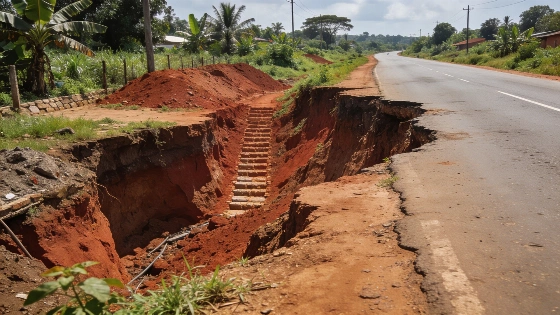
Residents at Umuchiani had begun dismantling parts of their homes as erosion threatened to cut off the Ekwulobia-Oko road. Peter Obi arrived at the site by 6 a.m. Work began the following morning, and the erosion was eventually arrested and stabilised.
Valentine Obienyem cites the episode in response to PBAT's accusation, during a visit to Akwa Ibom, that Obi did nothing about erosion while governing Anambra State. Anambra has more than 1,000 active erosion sites and is among Nigeria's most severely affected states. The Nanka-Agulu erosion complex is one of the country's most devastating.
Emergency responses and a regional campaign
Obi's approach, Obienyem recounts, was to be woken when bad news came, because that was when his attention was most needed.
A distress call brought him to the Omagba axis of the Nkpor-Onitsha dual carriageway, where residents were evacuating an endangered building. Crews controlled the erosion before it swallowed the building.
His advocacy extended beyond individual sites. As Chairman of the South-East Governors' Forum, Obi argued that the region should be declared an ecological disaster zone so it could receive urgent attention. Obienyem credits that push with helping bring about the Nigeria Erosion and Watershed Management Project (NEWMAP), a World Bank-assisted programme addressing erosion and watershed degradation.
At NEWMAP's official launch in Abuja, then Minister of Environment John Odey said Obi had almost single-handedly pushed for the project's creation, even when some colleagues were lukewarm. World Bank Country Director Marie-Françoise Marie-Nelly commended Obi's commitment, including his being the first governor to pay the state's ₦500 million counterpart contribution. The project covered Anambra, Imo, Ebonyi, Enugu, Abia, Edo and Cross River.
A later World Bank climate-resilience and sustainable-landscapes programme sets targets for 2031 to restore landscapes, rehabilitate watersheds and improve erosion and flood management across 1.4 million hectares. It expects 6.6 million people to benefit, according to the World Bank programme announcement.
The distinction between an accusation and a documented response also appears in the Abuloma investigation, where Rivers police suspended the outpost DPO and another officer while probing reports about renovations at the facility.
Nearly 40 sites across Anambra
By the time Obi left office, his administration had worked on nearly 40 erosion-control and storm-water management sites. Most were completed, while work continued at some others. Major sites included Umuchiana, Ekwulobia; Mbaukwu; Mbanabo-Umuogba/Bishop Uzodike Road, Nnewichi, Nnewi; Umunze-Uga; Umudiana, Adazi-Nnukwu; Nsugbe; and Utu/Osumenyi in Nnewi South.
Other interventions covered Okpuno, Uwani Village and Ebenebe; Inyaba Umudim, Nnewi; Umuchu; Iyiagu floodplain restoration in Awka, Phases I and II; St Patrick's Catholic Church, Awka; New Tarzan Junction, Agulu Avenue; Okpuno-Umuota, Obosi; St Anthony's Catholic Church, Ifite; New Era Girls' Secondary School, Onitsha; Silgrey Hospital, Awka; Umuokpu, Awka; St John of God Secondary School, Awka; and St Theresa Catholic Church, Agulu.
Further work included dredging the Nwangene River in Onitsha and desilting the Okpoko/Obodouwku road channels and Okpoko Creek. Crews also desilted the Sacamori channels in Fegge and Housing Estate, Onitsha. Erosion-control works took place at Ugwu-Ogbada Village, Umueze; Odo Araba; Chief Eredu; St Mary's and St Luke's Anglican Churches, Obosi; St Pius Primary School, Ifite-Nimo; Ibollo-Unodu, Oraifite; Ubahu/Ozuluogu, Ebenator; St Gabriel Catholic Church, Okpuno; and the Teaching Hospital, Agulu.








