
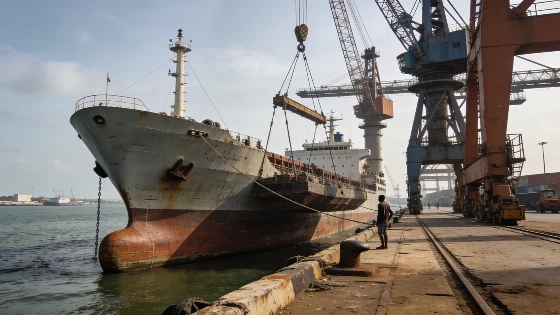
At the 2026 World Maritime Day celebration in Lagos, former NIMASA chief Mfon Usoro questioned whether Nigeria’s blue economy policy was delivering tangible progress. She urged the country to align agencies and set measurable benchmarks. Nigeria accounted for more than 46 per cent of port calls in the Gulf of Guinea in 2025, NIMASA Director-General Dr Dayo Mobereola said, as Business Post reported.
Usoro wants an Integrated Blue Economy Environment Structure to coordinate ministries and agencies at every level of government. She also called for clear, measurable performance indicators so officials can track progress and answer for results. The structure would coordinate the agencies responsible for carrying out the policy.
Turning policy into delivery
Speaking in Lagos on Friday at the 2026 World Maritime Day celebration, Usoro delivered a keynote address under the theme, “From Policy to Practice”. The event programme listed her address as “From Policy to Practice: Strengthening Nigeria’s Blue Economy”, as Blueprint Newspapers reported. She said the theme reflected the International Maritime Organisation’s focus on applying regulations to deliver practical gains for seafarers, port workers, ship operators and maritime administrators.
The Federal Government established the Ministry of Marine and Blue Economy in 2023, and the national policy won approval in 2025. Usoro said it adopts a broad definition of the blue economy, reflecting international thinking while accounting for Nigeria’s geography.
That definition covers oceans and coastal waters, inland waterways and rivers, lakes and wetlands, mangroves and deltas, as well as dunes.
Nigeria entered the policy’s implementation phase in 2026. It covers five areas: maritime trade; fisheries and aquaculture; marine resources; energy and environmental sustainability; and blue tourism and recreation.
Usoro proposed clearly defined membership for the Policy Advisory Council. Ministers responsible for transport and finance should sit on it, with petroleum, environment, budget, defence and agriculture also represented, alongside experts and relevant stakeholders. The council, she said, should develop strategies together, agree on shared goals and commit to planned programmes.
Shipping incentives and competitiveness
Sections 36 and 37 of the NIMASA Act require the ministry and agency to implement incentives for Nigerian shipping companies with national-carrier status, Usoro said. She linked Nigeria’s weak performance in port logistics to poor liner-shipping connectivity, which she said hindered the global competitiveness of its ship registry.
Mobereola pointed to four years without reported piracy incidents. Nigeria won re-election to the IMO Council after 14 years, and the United States lifted its Condition of Entry. NIMASA has also automated the ship registry. Mobereola said safer waters had boosted investor confidence, while registry improvements made the Nigerian flag more attractive. Higher standards, he added, had expanded opportunities for seafarers.
Mobereola called for sustained investment and stronger collaboration between agencies. He also urged lasting partnerships between government and the private sector, with maritime stakeholders involved.
The government has set out port upgrades beyond Lagos. Modernisation is planned for Onne, Warri and Calabar. Proposed deepwater ports include Agge and Bakassi, with plans also naming Bonny and Gateway, as well as Ibom and Ondo.
The projects are intended to expand capacity and connect seaports with inland dry ports and production centres. The plan includes road links, rail connections and inland waterways.
At a Chartered Institute of Logistics and Transport Nigeria conference, Marine and Blue Economy Minister Adegboyega Oyetola said the government had approved $1 billion for upgrades at Lagos’s Apapa and Tin Can Island ports, as BusinessDay reported. Oyetola said the work would increase port capacity and create a more digital, paperless operating environment. The ministry has also reported that fish production rose from about 1.1 million metric tonnes to 1.4 million tonnes in 2025.








