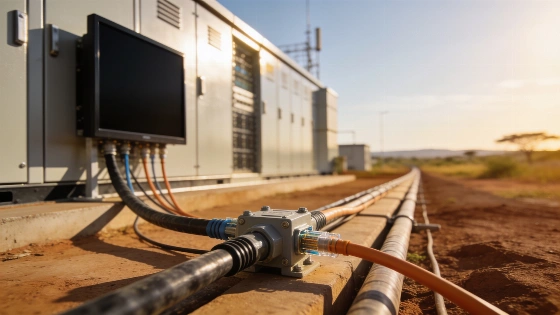
Africa records more than 100,000 fibre cuts a year, according to Yongqiang Yuan, VP Optical Business Product Line at Huawei. Yuan said each dollar invested in network resilience saves five dollars in losses. He made the remarks at the World Broadband Association's (WBBA) Broadband Development Congress during Africa Tech Festival 2026, as ITWeb reported.
The risk of a single break cutting off an entire route shaped calls at the congress. Leaders urged countries to connect their national networks through a terrestrial backbone, with submarine cables providing backup when a link fails. Huawei proposed a meshed fibre network that could reroute traffic after a break, using submarine and terrestrial systems as mutual backup.
Direct routes across borders
Amu Maja, Openserve's executive for Carrier and Global, proposed an open-access backbone running north to south and east to west, linking regional hubs and connecting submarine landing stations to inland networks. He said inland countries dependent on one cross-border link can lose all connectivity after a single fibre cut. Maja argued that data centres in Nigeria and Ghana should be able to connect directly. He also called for aligned licensing and access rules, with shared interconnection requirements, infrastructure maps and construction standards to support cross-border routes. Maja said public-private partnerships and transparent access arrangements would be important to developing the network, a proposal IT-Online covered.
A separate revived fibre proposal between the Central African Republic and the Democratic Republic of the Congo also concerns a direct cross-border route. That report said no construction timetable or cost had been announced.
Dr Jacob Munodawafa, CEO of the Southern Africa Telecommunications Association (SATA), said networks designed to detect faults and reroute traffic automatically were planned for the region. He called for border-spanning network design. Huawei's proposed performance targets include latency of 1 millisecond within metropolitan networks. The company recommends 5 milliseconds nationally and 20 milliseconds to neighbouring countries. Huawei also outlined terabit-per-second data-centre interconnection. Its recommendations include 10 Gbps connections for campuses, while schools, hospitals and banks would get 1 Gbps access. These are Huawei recommendations for network design, not regulatory standards.
Infrastructure for locally relevant AI
Africa accounts for 1 percent of global data centre capacity, according to the source material. Speakers argued that expanding this infrastructure and strengthening fibre links would support AI models developed for local languages and conditions. Ziaad Suleman, CEO of Cassava Technologies South Africa and Botswana, warned that models built far from the continent may fail to understand local context. Cassava was reported to operate about 120,000 kilometres of terrestrial fibre alongside fixed wireless and satellite capacity, as well as undersea capacity. It also operates five African data centres: two in Johannesburg, one in Cape Town and one each in Kenya and Nigeria. TechTrendsKE also reported Suleman's position that AI needs more than computing hardware.
The WBBA launched its ION-2030 initiative in Africa at the congress. Developed by the International Telecommunication Union (ITU), the strategy is intended to support collaboration on fixed networks and connectivity quality. WBBA director general Martin Creaner said strong access networks must be matched by capable backbone and data centre networks.
The WBBA has close to 300 member companies in 60 countries. Its AI research included interviews with 350 operators, according to the source material.