
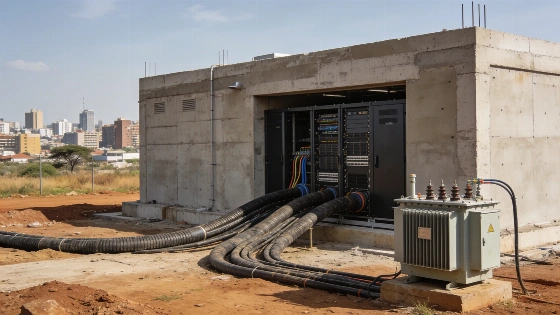
Africa’s $3.5 trillion economy accounts for just 1% of the world’s data-centre population, while much of the continent’s digital traffic still passes through Europe. A World Bank assessment shows the scale of the infrastructure gap: Sub-Saharan Africa, home to about 18% of the global population, holds 0.6% of worldwide data-centre capacity, and only about 5% of African data centres can support AI workloads. That gap sharpens a warning from Cassava Technologies chief executive Hardy Pemhiwa: Africa could miss a much larger economic shift than mobile money unless it builds capacity to host AI.
On BBC Africa Enterprise, Pemhiwa said mobile money brought millions of previously unbanked people into the financial system, while AI could help people excluded by language barriers. “Where the mobile money revolution was about bringing the previously excluded into the financial environment, AI is about bringing everybody else who was excluded by virtue of language,” he told host Nancy Kachungira. He said AI could have a “100x impact” compared with mobile money. In an interview reported by The Star on 29 October 2026, Pemhiwa warned that without African AI-computing capacity, the continent could repeat the pattern of exporting raw materials and importing higher-value products.
Local data and computing capacity
The scale of mobile money offers a benchmark. GSMA’s 2025 State of the Industry Report on Mobile Money said the global industry had more than two billion registered accounts and over 500 million monthly active users in 2024; Sub-Saharan Africa accounted for more than one billion registered accounts. GSMA data cited in the report put annual transactions in Sub-Saharan Africa at roughly $1.4 trillion. Basic Bank of Kenya figures recorded 94.2 million registered mobile money accounts by June 2026. The Basic Bank of Kenya’s work on financial supervision also includes a training agreement with Toronto Centre.
Pemhiwa warned that without local computing platforms African countries could export raw data and pay to use finished products built elsewhere. “If we don’t have our own AI compute solutions and our own digital infrastructure on the continent, we are repeating exactly the same pattern that we have seen over the years,” he said on BBC Africa Enterprise. “We’ve done it with cocoa; we’ve done it with minerals. The data sits here with us. It doesn’t have to be exported.”
The commercial case, he argued, lies partly in information specific to the region. Global AI models may lack extensive local material such as decades of South African mining data or patient records from referral hospitals in Kenya and Uganda. Citizen Digital reported that Cassava Technologies’ infrastructure plans include a 110,000-kilometre fibre-optic network from Cairo to Cape Town, alongside AI data factories in regional hubs. The planned hubs include South Africa, Kenya, Nigeria, Egypt and Morocco.
The World Bank’s Africa’s Pulse report, published on 6 October 2026, also found that public-service AI deployments remained basic in nine of the 15 countries assessed. Reliable electricity, connectivity, cloud access and locally representative data were among the constraints identified in reporting on the assessment by We Are Tech Africa. The figures and project plans describe an chance, not proof that the infrastructure or economic gains are already in place.
Power is a constraint on expansion
AI data centres need large, uninterrupted electricity supplies. The International Energy Agency says Africa has 60% of the world’s solar potential but generates only 1% of global solar power. Building computing capacity so depends on whether power projects can be financed and connected to reliable supply. The infrastructure build-out also requires investment in fibre, facilities and power, alongside operational ability to recover.
Linda Mabhena-Olagunju, founder of DLO Energy Resources Group, said early-stage funding remains a major obstacle. The local independent power producer helped raise $350 million for a wind farm described as powering 300,000 homes. On BBC Africa Enterprise, she said investors frequently avoid the costs and risks involved before a project is ready for construction.
“Most of the funding we need on this continent is for early-stage development. When there’s a piece of land that has absolutely nothing on it, when it requires permitting, a feasibility study, grid studies... no one is looking at deploying capital to the early-stage risk,” Mabhena-Olagunju said.
She called for clear regulatory frameworks and integrated resource plans to give investors confidence. She also argued that greater use of local capital would keep more returns on the continent: “When you have a local developer, the dividends we make stay on this continent. We should really be thinking about how we invest in local developers and local manufacturers because the job is created here.”








