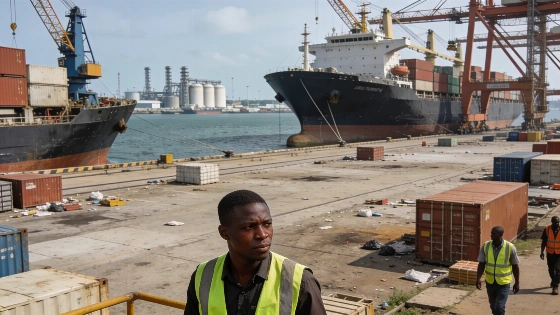
Federal approval for five new deep sea ports has set off alarms among Nigeria’s licensed customs agents. The National Council of Managing Directors of Licensed Customs Agents (NCMDLCA) says the country’s maritime sector is already losing cargo to faster, better-run ports in the region.
In October 2026, Ogun State, DP World, and Ogun Deep Sea Port Company signed two memoranda to develop the Gateway Deep Sea Port and a 10,000-hectare special economic zone, with potential investments exceeding $7 billion.
“You don’t build seaports; in a country like Nigeria, you only need one seaport. One deep seaport, which is a transshipment centre, a load centre, so that seaport can now accommodate Nigerian goods,” Amiwero said in Lagos. He warned that adding more ports without strong infrastructure or enough cargo only fuels waste and weakens Nigeria’s position in West and Central Africa.
He points to the numbers: Nigeria controls nearly 78 percent of the region’s cargo, but still falls short on throughput. “How many ports does Ghana have? Just one. The other one is a fish port. Their throughput is higher than Nigeria’s because of efficiency,” Amiwero said. He draws a line between Nigeria’s scattered approach and the focused, high-performing ports in neighboring countries.
Questions about the Lekki Deep Seaport keep surfacing. Amiwero doubts its rail links and whether it can handle the biggest container ships. Yet a 2023 BusinessDay report confirms Lekki Deep Sea Port opened in January 2023 as Nigeria’s deepest and largest, drawing new investment into port infrastructure.
Despite industry debate, the Nigerian government has pressed ahead with port expansion: by 2026, deep seaport projects in Badagry, Olokola, Ibom, Bakassi, and Bonny were confirmed, with Agge and Gateway/Ogun added later. This marks a strategic shift to diversify Nigeria’s port network and create new trade corridors.
Amiwero wants a full review of Nigeria’s port system by maritime professionals, not politicians. He singles out the Lagos Port Complex, Tincan Island Port, Lekki Deep Sea Port, and Calabar Port as needing urgent attention. Building more ports in other regions, he says, won’t attract cargo unless industries and markets are in place to support them.
He also calls for transparency on port concession and lease deals, especially where contracts have lapsed. The government, he says, should align stakeholder activities and set up a strong legal framework for port management. Amiwero points out that Lagos dominates cargo flows because that’s where the manufacturers and markets are, not because other regions lack ports.
With the maritime sector at a standstill, customs agents are pushing for a reset: focus on efficiency and professional oversight, or risk watching Nigeria’s cargo slip away to regional rivals.