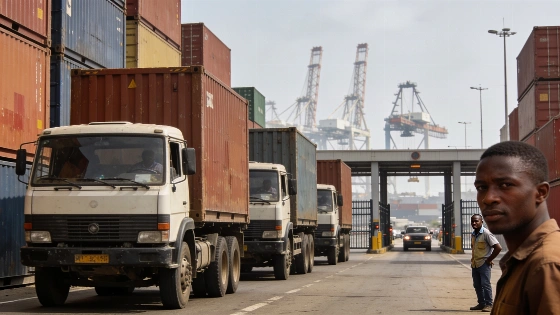
At Ghana’s Tema gateway, vessel delays reached four to seven days during the summer peak. They remain around six days despite reported improvements in terminal capacity. October 2026 figures put average waiting time at about 5.8 days in Tema. Abidjan averaged around 4.5 days, with some vessels waiting as long as 12 days, FreshPlaza reported.
More cranes and yard equipment cannot clear a bottleneck if containers cannot leave the terminal.
The strain reaches well beyond the quay. Drewry’s Eirik Hooper said Tema’s delays reflect a mismatch between investment inside the terminal and the transport infrastructure serving it. The Ghana Ports and Harbours Authority has identified imports and empty containers as major contributors, along with road congestion. In October 2026, Ghana Customs stepped up monitoring of container movements and surveillance in key port operating areas after reports of missing cargo, GhanaWeb reported.
That same month, the Ghana Railway Development Authority reported an expansion of container rail haulage from Tema under a programme with the Ghana Ports and Harbours Authority and private operators. GRDA chief executive Frederick Appoh said rail was moving about 220 containers a day. The programme’s target is above 200 daily. It moves loaded and empty containers to the Kumasi Unity Terminal, aiming to reduce reliance on trucks and ease accumulation at the port. The plan is for containers to travel between Tema and the inland terminal as needed on a just-in-time basis. A direct rail connection to Kumasi Unity Terminal remains a priority project. The programme is being carried out with private operator Integrated Services Solution, Starr FM reported.
At the country’s largest container hub, Ghana Customs’ tighter monitoring covers cargo movements and key operational areas. The measures address risks as containers pass from the terminal to transporters, then through storage facilities and on to inland destinations.
West African container throughput rose 19.4% year on year last year, according to Drewry. The increase coincided with larger vessels entering Asia-West Africa services. The Loadstar has also reported developing trade between West Africa and Latin America.
The arrival of 24,000 teu vessels on MSC’s Africa Express service added pressure. The service began last April and was calling at Lomé, Tema, Abidjan and Kribi by May. Hooper cautioned that conditions differ considerably between ports.
Douala operated at 102% utilisation last year as volumes rose 48% year on year. Conakry, Dakar, Lomé and Pointe-Noire each ran between 81% and 84% utilisation. Lomé handled about 2.4m TEU in 2025, up from 2.06m TEU in 2024, a rise of roughly 16%. The port also serves as a transit hub for Sahel countries. That links its container growth to inland corridors as well as domestic demand, Ecofin Agency reported.
At Tema, slow container evacuation and truck shortages can keep yards full. Customs delays and limited off-dock storage add to the strain, cutting waterside productivity. A terminal may have more capacity on paper yet still struggle to move cargo efficiently through the wider system.
Abidjan added yard equipment in 2025, but average vessel waiting times climbed from 0.4 days in February to 2.2 days by the end of August. Douala presents a different case: it is handling volumes above capacity, while other ports have modern terminals but inadequate inland connections.
DP World Africa chief executive and managing director Mohammed Akoojee argues that port expansion must be matched by investment in roads and rail. Inland logistics also need investment, alongside modern equipment and deeper berths.
DP World says its $340m modernisation of the Dakar terminal lifted throughput from 265,000 teu in 2008 to 850,000 teu in 2025. The operator says vessel waiting times fell from 35 hours to near zero.
Even productive terminals face physical limits, Akoojee said, particularly where further expansion is restricted. DP World’s $1.2bn investment in the new deepwater port of Ndayane is intended to handle larger vessels and future trade growth. Its first phase is planned to handle 1.2m teu annually.
Ndayane is one part of a wider wave of port development. New terminals are planned at Pointe-Noire and Banana in the Democratic Republic of the Congo. Nigeria has projects underway, while San Pedro, Takoradi and Luanda are seeing expansions.