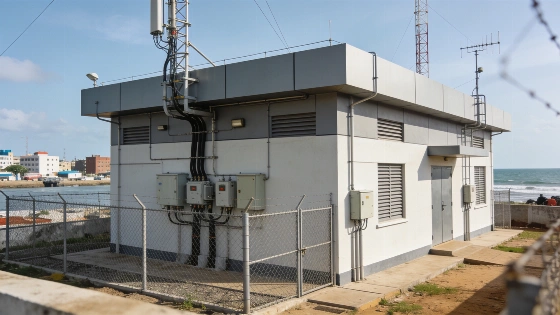
The planned system at Dolphin Telecom’s Lagos cable landing station is expected to generate more than 144 megawatt-hours of electricity a year. Over the ten-year agreement, that would amount to nearly 1.5 gigawatt-hours, supplementing the station’s existing power sources.
Grid Crux Energy Solutions, a Nigerian developer, will take the project from design and financing through construction. It will then manage the installation for the full ten-year term under the Energy-as-a-Service agreement.
A dedicated power system for the ACE landing station
Dolphin Telecom, a UAE-based telecom infrastructure provider, signed the deal with Grid Crux. The planned solar system is intended to cut the station’s reliance on diesel generation while working alongside its existing power sources, according to BeBeez International.
The Lagos station is where the international Africa Coast to Europe cable reaches shore. The route runs roughly 17,000 kilometres and connects 18 points across 18 countries. It includes Nigeria and Benin. France and Gambia are also on the route, along with Guinea and Portugal. The cable reaches Senegal and Sierra Leone, as well as Spain and South Africa. The Guardian also reported that Grid Crux will design and finance the system, oversee construction, then manage it under the ten-year contract.
Nigerian telecom infrastructure faces persistent power-supply problems. Industry analysis by Okoh Aihe in Vanguard describes operators’ reliance on public electricity and diesel generators. It also covers solar power and batteries, alongside hybrid systems. At some telecom sites, the public grid supplies only about 5% of daily power needs.
In 2024, Nigeria’s communications regulator classified telecom towers and base stations as critical national information infrastructure. The designation also covers fibre-optic cables. Data centres and submarine cable landing stations are included, according to ThisDay. The Lagos facility is part of the shore-side infrastructure connecting ACE’s international cable capacity with national and regional networks.