
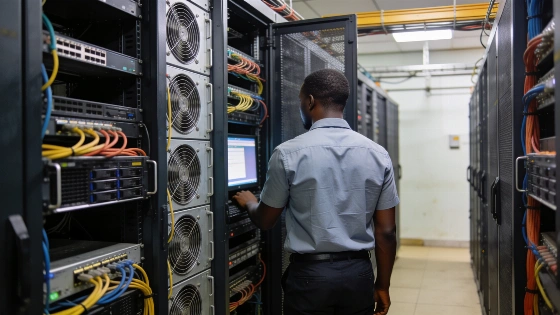
Digifloat LLC Chief Executive Officer Faisal Orakzai estimated that more than 90 per cent of data generated in Nigeria is hosted abroad, while annual offshore cloud spending stands at about $850 million. He says Nigeria needs to get more from its existing data centres by developing the software and services that can attract workloads.
Speaking at the Digital Nigeria International Conference and Exhibition in Abuja, Orakzai argued that the country's data sovereignty depends on who controls the platforms used to access and process data, as well as where servers are located. He called for a sovereign AI stack built on existing facilities. Nigeria's National Information Technology Development Agency (NITDA) has also identified data centres, cloud services and computing capacity as necessary infrastructure for AI development, while noting that skills and standards are part of the required foundation, as NITDA outlined in its strategy review.
Infrastructure needs local workloads
Orakzai said Nigeria has more than 20 data centres and is Africa's second-largest data-centre market after South Africa. Investment, he said, has gone mainly into hosting infrastructure, leaving the other layers of a sovereign cloud less developed.
He described those layers as hosting infrastructure, data platforms, security operations, AI models and applications. Without them, he said, agencies may get a virtual machine or rack at a local facility but still need to build the systems that make it useful or obtain them from foreign providers.
NITDA's locally developed N-ATLAS illustrates the importance of those software and adoption layers: it is an openly released language model with 8 billion parameters, accompanied by four speech-recognition models incorporating Nigerian languages. The agency reported more than 140 registered collaborators and 18 third-party applications certified for integration, while saying commercialisation and sustained adoption remained at an early stage. NITDA also cited Nigeria's rise to 70th place in the 2025 Government AI Readiness Index, up from 103rd in 2023.
That gap matters as more than $2 billion in data-centre investments are expected in Nigeria through 2027, Orakzai said. Operators need enough workloads to support returns, he warned. A Central Bank of Nigeria directive requiring covered financial institutions and payment service providers to store and manage payment transaction data generated in Nigeria locally by Jan. 1, 2027, could also encourage demand for domestic infrastructure. Separately, the U.S. Trade and Development Agency is funding a feasibility study for two proposed AI-ready data centres in Lagos and Delta states. Jimmy Mauldin, Chargé d'Affaires of the U.S. Diplomatic Mission in Nigeria, said digital infrastructure investment can create jobs, attract capital and strengthen resilience, as Radio Nigeria reported.
Local control and operating capacity
Orakzai said pricing sovereign technology services in Naira could reduce exposure to exchange-rate movements in government and private-sector technology budgets. He advocated a shared platform for public agencies and a hybrid approach using locally developed solutions alongside imported sovereign systems and licensed software, rather than building every technology from scratch.
He also called for Nigerian engineers to be trained to operate and maintain the platforms. NITDA has also opened a review of its Strategic Roadmap and Action Plan ahead of a new strategy in 2027, with digital infrastructure, computing capacity and AI development among the issues under discussion.








