A temporary radio-frequency licence put MTN’s Randburg headquarters at the centre of a test using 400MHz of spectrum. On 13 October 2026, MTN South Africa and Huawei reported a peak download speed of 10.35Gbps in a 5G-Advanced trial there. They called it Africa’s first 5G-Advanced trial in the Upper 6GHz band, as MyBroadband reported.
That peak came from controlled conditions at one site. It is not a speed available across MTN’s existing network. A customer’s result would depend on their device. Signal conditions and distance from a site also matter. So does the number of people sharing network capacity.
What the Randburg test demonstrated
MTN ran the trial under a temporary licence from the Independent Communications Authority of South Africa, or ICASA. The spectrum was not commercially assigned. MTN describes the test as Africa’s first combination of 5G-Advanced technology and the Upper 6GHz band.
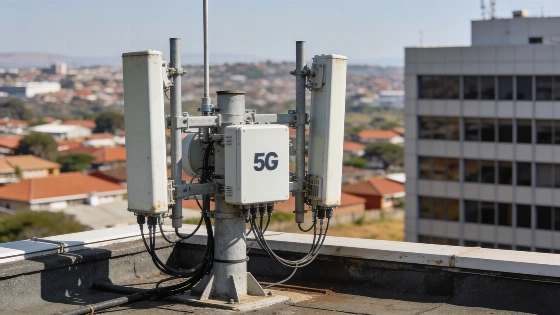
The setup used a dedicated 5G Standalone core alongside ultra-wideband active antennas. It also applied advanced beamforming. The core supports advanced network functions, while a wide channel gives the radio system more spectrum to carry data. Beamforming helps direct transmissions towards specific devices and manage network resources. TechCentral’s report details the configuration and its 400MHz channel.
At 10,350Mbps, the reported peak shows what the equipment delivered in the trial. It says little about the speeds customers would get across a live network.
Capacity comes with coverage trade-offs
Upper 6GHz runs from 6.425GHz to 7.125GHz, a total of 700MHz. MTN used a 400MHz portion. In July 2026, ICASA’s updated National Radio Frequency Plan 2026 identified the full Upper 6GHz range for International Mobile Telecommunications, or IMT. That category covers mobile broadband technologies such as 5G and potentially 6G. The designation does not allocate the band to MTN or any other operator. By 14 October 2026, no operator had received a commercial Upper 6GHz licence.
The extra spectrum could help operators handle data demand and support advanced 5G services. Higher-frequency signals face greater propagation losses. They can also have more trouble penetrating buildings than lower-frequency signals, so antenna placement and supporting infrastructure matter for coverage. A peak speed does not establish what a nationwide rollout would cost or how widely it would reach.
MTN has named fixed wireless access as one possible use, including in communities where extending fibre to homes can be difficult or costly. The operator already sells AirFibre through dedicated point-to-point wireless links. A future Upper 6GHz deployment would use a different radio configuration.
The band could also add capacity at busy locations. MTN cited transport hubs and shopping centres as examples. Stadiums and university campuses are other potential sites.
South Africa’s spectrum decisions will determine whether operators can use Upper 6GHz commercially. ICASA opened the lower 6GHz range, from 5.925GHz to 6.425GHz, for Wi-Fi in 2023. Its 2026 plan identifies Upper 6GHz for IMT, but that status does not give mobile operators automatic priority or rule out Wi-Fi. ICASA still has to set licensing terms. It must also decide how services will share the band and what technical conditions will protect them from interference. MTN’s temporary licence allowed a technology demonstration, not commercial access.
A higher peak than MTN’s 2024 trial
In November 2024, MTN and Huawei reported an 8.6Gbps 5.5G trial at the operator’s Johannesburg headquarters. That test used a different spectrum configuration and advanced antenna technology. The new peak is about 20% higher, but the trials were not a controlled comparison. They differed in spectrum and channel width. Equipment and network architecture also varied. Both were technical demonstrations, not measurements of typical customer speeds.
MTN South Africa chief executive Ferdi Moolman said the trial would help the operator assess how next-generation spectrum could expand capacity and improve customer experiences. Commercial benefits will depend on spectrum arrangements. Network investment, compatible devices and deployment economics will matter too. The Randburg test operated under a temporary ICASA licence. MTN and Huawei have also discussed further commercial verification of network solutions, as Hypertext reported.