
More than 100 French companies operate in Nigeria, generating approximately 14,000 direct local jobs across sectors including pharmaceuticals, agriculture, insurance, logistics, transport, infrastructure and hospitality. Figures reported during the 2026 French Week celebration put direct local jobs above 14,000 and French foreign direct investment stock at €8.1 billion in 2025. Their presence gives the bilateral relationship a large commercial footprint beyond headline trade figures, spanning sectors from agriculture and finance to energy and logistics, as Nairametrics reported.
Trade between Nigeria and France reached $4.7 billion in 2025, while French foreign direct investment stock in Nigeria stood at €8.1 billion. The stock figure represents accumulated investment, not new capital invested during 2025. Trade measures the exchange of goods and services; it is a separate indicator.
Port and transport plans face delivery tests
Agreements advanced in Paris in September 2026 in the presence of Nigerian President Bola Tinubu included plans for the Gateway Deep Sea Port and the adjoining Ogun State Blue Marine Special Economic Zone. The proposed developments could add logistics capacity and support industrial activity around the port. Jean-François Favier, a French representative involved in the bilateral commercial relationship, described Nigeria as France’s leading trading partner in sub-Saharan Africa and cited the port and special economic zone as examples of expanding cooperation, as The Guardian Nigeria reported. Their impact will depend on financing and implementation, supporting infrastructure and private-sector demand.
In Lagos, the Omi Eko water-transport project plans to introduce 75 electric ferries. It also includes upgrades to 25 terminals and 15 routes covering approximately 140 kilometres of waterways. The programme’s design includes dredged and marked channels, charging infrastructure, maintenance facilities, ticketing and vessel-tracking systems, with ferries intended to connect to rail, bus rapid transit and last-mile services. Its stated target is to increase water transport’s share of Lagos journeys from less than 1% to as much as 8% by 2032. If delivered as planned, the network could expand public transport options and ease pressure on some road corridors. Any effect on property values or rents will depend on route reliability and the infrastructure around them, information from project details outlined by Business Africa Online.
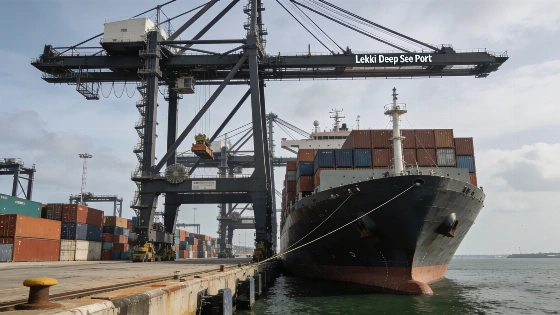
At Lekki Deep Sea Port, CMA CGM has agreed to operate the container terminal. The port’s reported annual handling capacity is 2.5 million twenty-foot equivalent units and its draft is 14 metres. Capacity alone, but, does not establish actual cargo volumes or demand for nearby warehouses. A report on Lekki cargo flows linked refinery operations to a large share of the port’s throughput, illustrating how industrial users can shape activity there.
Energy and agribusiness broaden the relationship
TotalEnergies’ investment decisions involving the Ubeta gas field and the IMA project form part of ongoing activity in Nigeria’s energy sector. Ubeta is intended to supply gas to Nigeria LNG’s Train 7 project, linking upstream production with gas-export capacity. French companies SPIE and Schneider Electric also work in energy and infrastructure services.
For businesses, reliable power and transport can affect operating costs and the viability of industrial sites. Those gains depend on project execution and dependable supply. Investment commitments alone do not establish that surrounding businesses will see measurable improvements.
The Franco-Nigerian Agri-Business Club is intended to encourage cooperation in mechanisation and local capacity building. Its focus also includes agro-processing and reducing post-harvest losses. Any expansion in processing or storage will depend on funded projects and sustained commercial partnerships.
Nigerian firms are building commercial links in France as well. JR Farms and Babafood have established activities there in agricultural production and agro-industrial trade. Flour Mills of Nigeria Group has expressed interest in expanding its presence in the French market. In technology, GecX60 has established a research and development centre within an Orange Group incubator in Blagnac, France.








