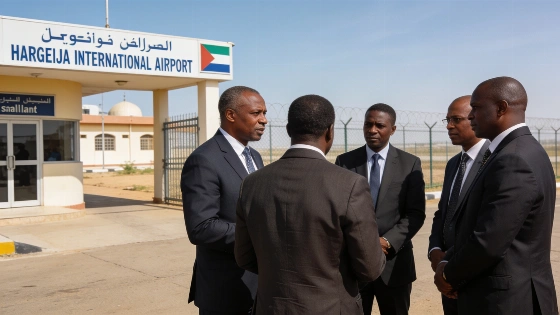
Somaliland’s government has started a new drive to take direct control of its airspace and border entry points. This move puts Somaliland on a collision course with Somalia, which still claims the territory as its own.
In December 2025, Israel became the first and only UN member state to officially recognize Somaliland since its 1991 declaration of restored independence.
Diplomatic moves and quiet negotiations
Minister Khadar, speaking to Somaliland diaspora in the United States, said Minister Fuad is handling the airspace issue “wisely and discreetly” and expects progress soon. Fuad is still in the United States, working on diplomatic efforts to clear what Somaliland sees as roadblocks to controlling flights in and out of its territory. Khadar tied this campaign to Somaliland’s wider diplomatic playbook, pointing to Israel’s recognition as proof that quiet talks can pay off. He did not share details about other ongoing negotiations.
Direct challenge to Somalia’s federal power
Running airspace and immigration is a core part of being a state. Somaliland’s push to take over both is not just about paperwork. It is a direct shot at Somalia’s federal power and a clear sign that Somaliland wants to act as an independent country. Somalia still insists Somaliland is part of its territory, but Somaliland says it restored its independence in 1991 and has been seeking international recognition ever since. The current fight over flights and entry rules shows just how far apart Hargeisa and Mogadishu now stand.
In March 2025, Somalia’s President Hassan Sheikh Mohamud offered the United States exclusive operational control over strategic ports and airbases, including facilities in Berbera. The authenticity of this letter was confirmed by Somalia’s Ministry of Foreign Affairs for the Associated Press, and Reuters also reported on the document.
Somaliland’s goal is clear: it wants to run its own airspace, borders, and international access without interference from Mogadishu. The government is keeping some of its efforts under wraps until it gets results, showing a careful approach to both diplomacy and building up its state functions.
For Somaliland, taking charge of airspace and border entry is more than a technical fix. It is a test of whether it can really act as a state on its own. The leadership is mixing public pressure with quiet diplomacy, showing it understands how tough it is to win international recognition. Whether these efforts will actually shift control remains uncertain, but Somaliland’s leaders are making it clear they will not accept outside management of their borders or skies. The outcome of this standoff will set the tone for how power is shared between Hargeisa and Mogadishu going forward.
On the other side, Somalia has started tightening movement inside the country. Since October 1, 2026, travelers moving between regions must show a national ID card or a document from the National Identification and Registration Authority (NIRA). Some Garowe–Mogadishu flights have been canceled because passengers did not have the right papers. This is part of Mogadishu’s push to tighten its grip on internal travel, as reported by Somaliatoday. These steps are meant to bring more order to domestic travel and boost the federal government’s control.
In the skies, the European Union Aviation Safety Agency (EASA) has kept its warning for Somali airspace in place until April 30, 2027. This warning is about aviation safety and does not mean there has been any official transfer of airspace control over Somaliland. The ongoing advisory highlights the tough security and regulatory situation in the region, as shown in a recent EASA update.