
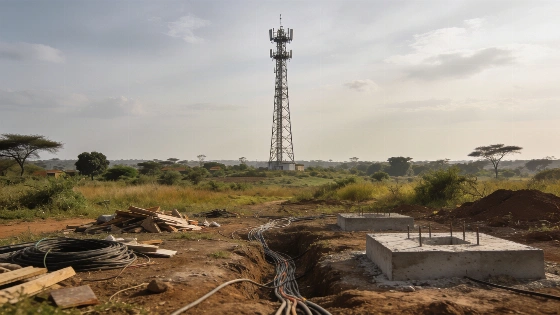
Microwave backhaul accounts for nearly 75 per cent of Indian operators’ total spectrum usage charge payments, information from the Cellular Operators Association of India (COAI), compared with about 25 per cent for access spectrum.
The industry body urged the government on 29 October 2026 to implement the Telecom Regulatory Authority of India’s recommendations to rationalise those charges, as ET Telecom reported. TRAI proposed replacing the existing slab-based structure with a uniform charge of 0.1 per cent of adjusted gross revenue per carrier for related to the topic bands, alongside annual point-to-point link charges ranging from ₹2,500 to ₹75,000 for specified spectrum bands. Microwave links connect mobile sites to basic networks where fibre is difficult to deploy or too costly. COAI has estimated that demand for microwave backhaul could rise three to five times over the next five years across most licensed service areas as 5G networks mature. The Department of Telecommunications’ draft Telecommunications (Administrative Allocation of Spectrum) Rules, 2026 reportedly retained the existing structure after TRAI’s recommendation.
A separate capacity-testing report covered 5G-Advanced trials in South Africa, a different part of network investment from the backhaul pricing issue COAI raises.
Tower revenue and network costs
Indus Towers has begun earning revenue from towers in Zambia and Uganda. Chief Financial Officer Abhishek Maheshwari said initial capital expenditure per tower remained within planned levels, supporting the company’s cost model. Airtel is the basic anchor customer in those African markets, and Indus is speaking with potential additional customers. The company planned to begin deploying towers in Nigeria in the following quarter.
In India, Indus added 2,869 towers during the September quarter. Its total base reached 270,480, up 5.6 per cent year on year. The company said it had deployed towers in Zambia and Uganda during the quarter and had started generating revenue from them, as The Economic Times reported.
Merger talks and regulatory scrutiny
Maxis and U Mobile have reportedly revived discussions about a possible merger in Malaysia. The combination could create the country’s largest wireless operator by market value and reshape competition with CelcomDigi. Bloomberg reporting cited by The Star said Maxis had asked selected banks and law firms to submit proposals to advise on a potential transaction. The discussions had not produced a final agreement.
U Mobile’s owners were reportedly seeking a valuation of around RM10 billion, compared with an earlier reported figure of RM14 billion. The lower figure is RM4 billion, or about 28.6 per cent, below the earlier amount. The proposed combination comes as Malaysian operators compete to expand 5G connectivity and attract customers.
In India, Bharti Airtel will pay a ₹2.14 lakh penalty imposed by the Department of Telecommunications’ Karnataka licensing service area over alleged subscriber-verification violations. The action followed a Customer Application Form audit that examined compliance with licensing conditions for verifying customers before issuing mobile connections.
Airtel said in its regulatory disclosure that it would not contest the penalty and would pay it. The disclosed financial impact is limited to the penalty amount.
COAI says a simpler, more predictable pricing structure could improve network economics and support 4G and 5G expansion. Its proposal includes annual per-slot charges for point-to-point links. The association has also said microwave backhaul demand could increase three to five times over five years as 5G networks mature.








