
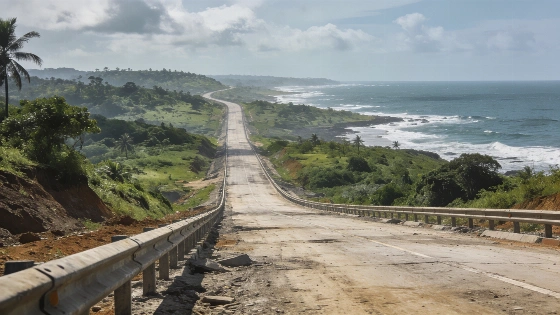
President Bola Tinubu says the Lagos-Calabar Coastal Highway could cut logistics costs by 15–20 per cent and add up to two per cent to GDP. He said it could also generate about 100,000 direct jobs and more than 150,000 indirect jobs. Tinubu presents the road as part of a wider effort to expand productive capacity and support Nigeria’s ambition to build a $1 trillion economy by 2030.
Projects and economic indicators
Tinubu named the Lagos-Calabar Coastal Highway, Sokoto-Badagry Superhighway and Trans-Sahara Superhighway, as well as electricity grid upgrades and port modernisation. He said the projects would strengthen Nigeria’s productive capacity. A separate Lagos airport report also examined how a major infrastructure project was funded.
On 27 October 2026, Tinubu asked the National Assembly to approve a 2026–2027 supplementary external borrowing plan comprising $20.52 billion and €1.045 billion. The proposed financing covers programmes in infrastructure, agriculture, healthcare, education, water supply, security, employment generation and financial-management reforms, with funds directed primarily toward power, transportation and healthcare. Reporting described the request as approximately $21.7 billion, while retaining the two separate currency amounts. Transportation projects account for about $10.6 billion, including the Lagos-Calabar and Sokoto-Badagry highways and the Kano-Kaduna rail project, as Finance Minister Taiwo Oyedele explained. Tinubu’s request still requires legislative approval.
In his essay, Tinubu cited real GDP growth of 4.43 per cent in Q2 2026. He also pointed to inflation at 14.63 per cent in September, external reserves of $55.1 billion and a tax-to-GDP ratio of 12.5 per cent. These figures formed part of his defence of borrowing.
The administration has presented the proposed borrowing as long-term infrastructure investment, with repayment periods intended to match the useful life of the assets and reduce refinancing pressure. Tinubu said Nigeria needed sustained infrastructure investment to reach its $1 trillion economy target by 2030. The borrowing request covers multiple sectors and projects; it is not solely for the Lagos-Calabar Coastal Highway. In a letter to the National Assembly, Tinubu said external borrowing was needed to help close the country’s infrastructure-financing gap.
“The real question is not how much we borrow, but what we build, what value we create and what future we leave behind.”
He said financing alone was not the achievement: “Completing the project, delivering value and improving the lives of Nigerians is the achievement.”








