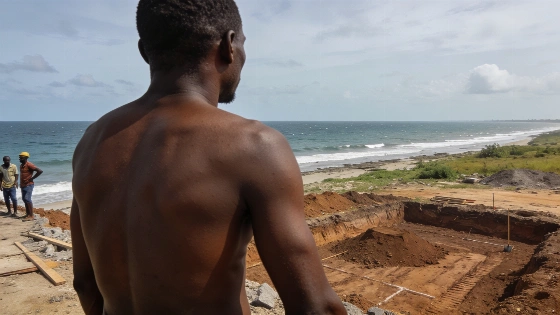
President Bola Ahmed Tinubu flagged off construction of the $3.5 billion Bakassi Deep Seaport in Ikang, Bakassi Local Government Area, Cross River State, on November 13, 2026. Vice-President Kashim Shettima represented him at the groundbreaking ceremony.
Governor Bassey Edet Otu said the project had received initial funding approval of $2.27 billion. Afreximbank has been identified as the project's financing partner. The announcement did not establish how much funding had actually been disbursed.
Financing and transport links
The project brings together the Cross River State Government and Arise Integrated Industrial Platforms (Arise IIP), with 80 per cent private-sector participation and 20 per cent state ownership. Its public-private partnership framework was formalised in February 2025. Conceived in 2014, the project has faced institutional, financial, legal and environmental challenges. An Environmental and Social Impact Assessment was developed in March 2015. The state says it has also completed hydrographic, geotechnical and geophysical surveys and secured federal approvals. The Cross River State Government's account describes the November ceremony as the start of implementation. It says the port is expected to open commercial corridors, stimulate industrialisation and create jobs.
The port is designed for a 20-metre navigational draft and is expected to include a deep-water harbour, container terminals and cargo-handling facilities, supported by logistics infrastructure. The 20-metre navigational draft is designed to accommodate large commercial vessels, although the port has not yet demonstrated operating capacity. The project's commercial case also depends on attracting shipping lines and terminal operators, as well as manufacturers and freight businesses capable of generating sustained cargo volumes.
A proposed six-lane tolled highway would connect the coastal site with inland commercial centres and provide a route for cargo evacuation. The Nigerian Ports Authority's stated plan, reported by TheCable, describes a 275-kilometre Calabar-Ogoja-Gakem superhighway. The Federal Government cited 260 kilometres at the ceremony. The wider plan also envisages links with Calabar airport and the Lagos-Calabar Coastal Highway. The proposed corridor is meant to serve inland Nigerian markets and could connect to regional trade routes towards Chad, Niger, Mali and Burkina Faso.
Economic case and delivery risks
Cross River expects the development to support logistics and shipping. Governor Otu has also named fishing, tourism and shipbuilding as potential beneficiaries. Other possible activity includes seafood processing and warehousing. The port could offer an alternative export route for cocoa and oil palm. The wider industrial ambition is to attract businesses that process raw materials and distribute goods through the corridor. Government and port officials have presented it as a potential eastern maritime gateway that could ease pressure on Lagos ports and strengthen trade links with West and Central Africa.
The state says it is preparing residents through specialised training, with plans to expand programmes for artisans, skilled workers and professionals. The scale of local employment will depend on project delivery and on whether industrial users establish operations around the port.
Shettima argued that Nigeria needs more than one major maritime gateway. "Lagos is not our enemy. Lagos is our elder brother in trade. No country eats with one hand. No country carries all its loads on one shoulder. That shoulder will break," he said. He added: "When Calabar works, Nigeria works on two legs."
The project's prospects build on an earlier report on the port plan, which described its stated aim of spreading maritime activity beyond Lagos. For the new gateway to operate commercially, the harbour and terminals will need reliable cargo evacuation, power, security and efficient customs procedures. The November 13 ceremony marked the start of implementation, not the completion of the port.