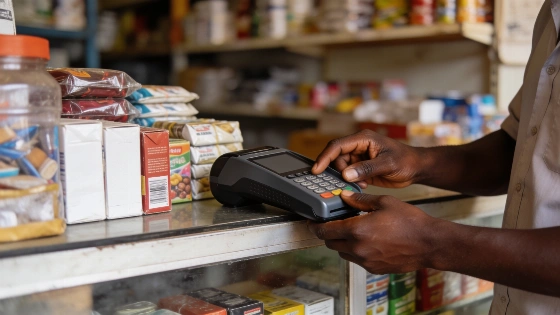
Safaricom says its M-PESA merchant network reached 3.13 million businesses by 31 March 2026, up from about 1.8 million a year earlier. In its FY2026 reporting period, which ran from 1 April 2025 to 31 March 2026, M-PESA processed approximately 46.4 billion transactions valued at KSh41.68 trillion. The transaction total covers broader M-PESA activity, not merchant sales alone. Volume rose 25.1% from 37.1 billion in FY2025, while transaction value increased 8.9% from KSh38.27 trillion, Techweez reported. That scale gives providers a large base for services built around merchant payments and transaction histories.
The commercial chance lies in building on payment relationships. Transaction records can help providers assess businesses for credit, while additional tools give merchants more services through an existing platform. Safaricom reported 41.7 million active M-PESA customers and capacity to process about 6,000 transactions per second in FY2026, compared with 35.8 million customers and 4,500 transactions per second in FY2025. M-PESA Kadogo accounted for 17.1 billion transactions, or 36.8% of FY2026 volume; the service offers zero-priced transfers up to KSh100 and merchant payments up to KSh200.
Kenyan platforms combine payments with business tools
NCBA’s digital-financial-services subsidiary, LOOP DFS, launched LOOP BIZ+ as a merchant platform combining payment acceptance with working-capital loans and supplier credit. Its point-of-sale service accepts Visa and other card payments, NFC contactless transactions, mobile money and LOOP transactions; checkout is also available through an app and web portal. The platform’s LOOP Discover marketplace lets participating merchants promote products to more than 500,000 consumers through the LOOP consumer app, Citizen Digital reported.
The platform includes AI-powered inventory management designed to track stock, forecast demand and recommend restocking. Merchant transaction histories can help determine eligibility for quick loans, overdrafts, supplier credit lines and longer-term financing. Supplier credit can be paid directly to named suppliers, and credit limits may rise as a business grows, subject to eligibility and approval. Merchants can also manage inventory through services connected to the same commercial relationship.
Absa introduced Absa Next in October as a digital interface for banking, payments, credit, savings, investments and business finance. People who are not existing Absa customers can access its services through the platform.
A separate Kenyan mobile-wallet initiative is covered in this planned wallet card report on Airtel Money’s Mastercard virtual card. Its stated purpose was to let users pay for international online shopping and digital subscriptions from a mobile wallet.
More services bring wider responsibilities
At Moonshot 2026, executives from Mastercard and Remita argued that merchants need services beyond transaction processing. OPay executives also pointed to cash-flow management and customer insights. The discussion covered fraud prevention, reliable support and staff training. A TechCabal report summarized the panel’s call for services connecting payments with merchants’ wider operations.
Paystack chief executive Shola Akinlade has described wider business infrastructure as basic to the company’s next growth phase, with an ambition to address needs beyond payment acceptance.
The competition also involves SACCOs. TechTrendsKE reported that regulated SACCO assets reached KSh1.21 trillion in 2025 as the institutions expanded their use of digital credit and payments. Their member transaction data offers another basis for services that overlap with those of banks and fintech firms.
Taking on lending and handling more merchant data increases the significance of providers’ financial services and data practices. TechTrendsKE’s coverage of the proposed National Payment System Bill said it would expand the Basic Bank of Kenya’s supervisory powers, including inspection and intervention. The report also described consumer-protection responsibilities in the proposed legislation.