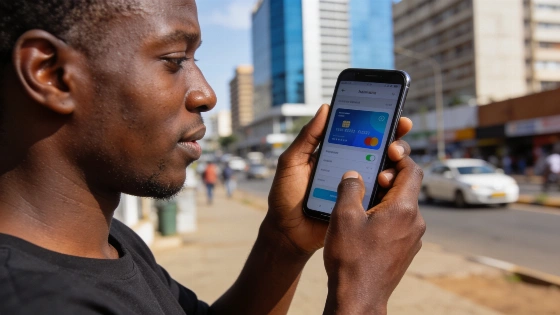
Airtel Money is about to shake up Kenya’s mobile payments. The company is rolling out a Mastercard-powered virtual card. This targets the international payments market, where Safaricom’s M-Pesa GlobalPay has been the main player. Millions of Airtel Money users will soon be able to pay for goods and digital services abroad. No bank card needed.
By June 2026, Kenya had 52.26 million connected smartphones, up from 50.18 million in March, expanding the potential audience for virtual payment cards.
Competition heats up in Kenya’s digital payments
Safaricom’s M-Pesa GlobalPay, launched with Visa in 2022, already lets M-Pesa customers pay online internationally with a virtual card. Airtel’s new card brings Mastercard into play. Now, Kenyans get a real choice between two global card networks for cross-border payments. The real difference will come down to fees, exchange rates, transaction limits, which merchants accept the card, and how easy it is to fix failed or disputed payments.
Airtel Money’s share in Kenya has jumped. Four years ago, it was under 2%. Now it’s about 11%. The agent network has grown from fewer than 20,000 to around 270,000. Airtel says it has over 24 million subscribers in Kenya, with about 6 million using Airtel Money. The Communications Authority of Kenya reports 54.0 million mobile money subscriptions as of June 2026. That’s up 13.2% from 47.7 million a year before. Airtel Money holds 11.1% of the market. M-Pesa still dominates with 88.8%. Official CAK statistics show that many customers use more than one wallet. Kenya’s digital payments scene is crowded and competitive.
Airtel’s product push and tighter rules
The virtual card is just one part of Airtel Money’s bigger plan. The company wants its wallet to be the go-to for all kinds of financial activity. Airtel has built up merchant payments, business tools like Bizna Wallet, and deals with banks such as KCB, Absa Bank Kenya, and I&M; Bank. Cashback offers like the Rudisha programme, which gives back 50% of certain transaction fees, are meant to keep users active on Airtel. Now, international payments are next. The wallet is moving from local to global.
As of June 2026, the Central Bank of Kenya had licensed 43 payment providers, including M-Pesa, Airtel Money, Equitel, Pesapal, and Loop, highlighting that competition in mobile payments is evolving within a regulated sector and not just between two telecom operators.
What this means for Kenya’s digital economy
Airtel Money’s Mastercard virtual card is a clear move to close the gap between local wallets and the global digital market. Customers will be able to pay international merchants straight from their mobile wallet. Airtel is betting that this convenience will drive more people to use its service. The company says that in one of its operating companies, the average transaction value jumped from $20 in March 2022 to $74 in June 2026. That’s a big leap.
The real test is still ahead. Kenyans can keep both M-Pesa and Airtel Money accounts and move money between them. Airtel’s growth depends on giving people a reason to use its platform. That could mean more agents, better digital tools, or new products like loans and savings. The virtual card is a smart addition. But it will only work if fees are clear, service is reliable, and the customer experience is smooth.
Airtel hasn’t set a launch date for Kenya yet. But the market is already shifting. Safaricom still leads in mobile money and mobile subscriptions. As of March 2026, it held 68.9% of mobile subscriptions and 62.7% of mobile broadband access, according to The Eastleigh Voice reporting. When the Airtel Money Global Pay Card launches, the fight for Kenya’s international payments market will get fierce. Both Airtel and Safaricom will have to compete on service, price, and new ideas. In Kenya, mobile money is part of daily life. The winner will be the one that connects local wallets to the world best.