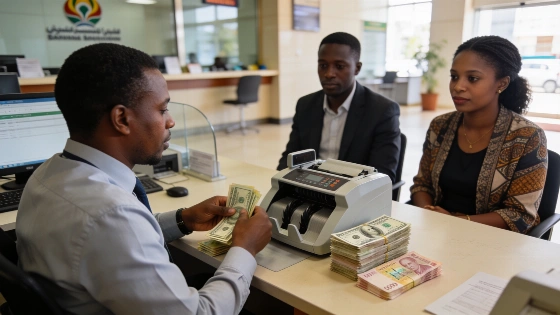
Four auctions. Five hundred million dollars. That’s what Ethiopia’s National Bank put into the market in just three months. The days of surprise interventions are over. Now, banks and businesses know exactly when and how much foreign currency will be up for grabs.
According to the International Monetary Fund, the NBE conducted 14 foreign exchange auctions totaling $2.5 billion over the previous 11 months, reflecting a significant increase in transparency and predictability.
Demand and supply find rare balance
Recent auction numbers tell a story. At Auction No. 28, commercial banks asked for about USD 120 million. That’s USD 5 million less than what was offered. All 20 banks got every dollar they requested. The next round, Auction No. 29, saw bids reach roughly USD 123.49 million. Still, that was just under the USD 125 million on the table. All 27 banks walked away with their full allocations.
This isn’t weak demand. It means the NBE’s auction size is hitting the mark for now. Banks aren’t scrambling for scraps. Supply is matching demand. That’s a big shift for importers and corporate treasurers who have long dealt with sudden shortages and wild swings. The Ecofin Agency market review notes that on September 23, the weighted average rate was about 160.23 birr per dollar. Demand came in just below the $125 million offered.
Operational clarity for banks and businesses
The new auction schedule does more than set numbers. It gives banks and their clients a clear view ahead. Importers can plan orders and payments with more certainty. Banks can manage their foreign currency positions without last-minute surprises.
After two September auctions, the NBE announced six regular sales of $140 million each for the second quarter of the 2026/27 fiscal year, totaling $840 million. These auctions are scheduled every two weeks from October 13 to December 22, 2026.
Signals for the future
The auctions are meeting short-term needs. But the bigger picture is still complicated. These sales only show demand from eligible commercial banks. Many businesses and sectors remain outside the process. Access to dollars depends on who qualifies, which banks take part, and how the NBE sets the rules. The central bank still decides when, how much, and how often auctions happen.
Investors and market watchers are waiting to see if this balance holds. If auctions keep coming in under-subscribed, the volumes may be enough. If bids start to outstrip supply, pressure could return. The NBE publishes results, auction frequency, and participation numbers. These will be key signals. The new quarterly cap of $840 million is a 68% jump from the previous $500 million. That’s an increase of $340 million, as the Ecofin Agency analysis points out.
The NBE’s shift to regular, fixed-size auctions is a big change for Ethiopia’s foreign exchange market. The immediate result is clear. Predictability now matters as much as volume for banks and businesses trying to get dollars. The real test comes next. If the system holds as the economy shifts, Ethiopia’s managed currency experiment could bring real stability.