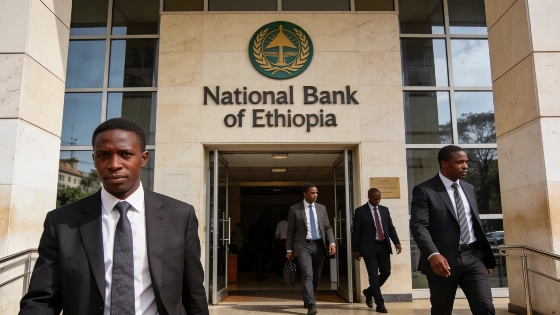
Six auctions. 840 million US dollars. The National Bank of Ethiopia is about to flood the market with foreign currency in the second quarter of 2026/27. Each auction will offer 140 million US dollars to commercial banks.
Over the previous 11 months, the National Bank of Ethiopia conducted 14 foreign exchange auctions totaling 2.5 billion US dollars, following IMF recommendations to maintain a transparent and predictable schedule.
Recent numbers show a market still adjusting. In May, the central bank put up 500 million US dollars. Banks wanted more than double that—bids hit 1.06 billion US dollars. Earlier auctions ranged from 70 million to 500 million US dollars. The bank kept changing the supply to match what the market wanted. By September, the gap between supply and demand shrank. On 23 September, banks bid for 123.49 million US dollars. The bank offered 125 million. Only 1.51 million US dollars went unclaimed. All 27 commercial banks got a piece of the pie.
The central bank is tweaking its approach. It sizes auctions to fit demand and tries to avoid wild swings. Publishing the auction calendar is now standard. Banks can plan ahead. The regular auction volume jumped by 340 million US dollars, or 68%, over last quarter. The previous quarter had four auctions of 125 million US dollars each. Now there are six, each at 140 million US dollars. This is detailed in an Ecofin Agency analysis.
Reform momentum and market infrastructure
The auction schedule is just one part of a bigger overhaul. Since July 2024, the National Bank of Ethiopia has changed rules on export proceeds, forward FX deals, and how banks handle foreign currency accounts. Banks now have more power to process a wider range of trade-related foreign exchange deals.
Despite the expanded supply, demand in September fell short of the auction limits, with banks submitting fewer bids than the available allocation in both September auctions. This stands in contrast to the aggregate foreign currency shortfall of commercial banks, which the IMF estimated at approximately 1.4 billion US dollars as of the end of April 2026.
The next quarter will test this new approach. The National Bank of Ethiopia is betting that regular, open auctions can steady the market and help banks get the dollars they need. Will it work? That remains to be seen. For now, the central bank is showing it can adapt and keep lines open with the market. Ethiopia's currency story is still unfolding.