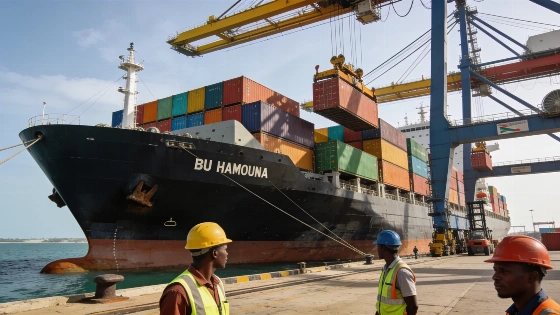
MV Hamouna, a 366-metre container ship operated by Islamic Republic of Iran Shipping Lines (IRISL), unloaded 5,200 TEUs at Lamu Port, the largest single-vessel discharge in the port’s history. That volume also exceeds any single-ship discharge recorded at Kenya’s basic port in Mombasa.
Kenya Ports Authority boss Captain William Ruto put it plainly: “This is the first vessel to discharge over 5,000 TEUs at once. Even our Mombasa Port has not surpassed this figure, making Lamu Port the next frontier in the maritime industry.” MV Hamouna travelled 14 nautical miles through the Eastern Channel before docking. The port has three operational berths, each 400 meters long, and natural channel depths of approximately 17 meters. Its berths reach 17.5 meters, allowing it to handle Panamax and Post-Panamax vessels exceeding 10,000 TEU capacity. Details appear in a Capital FM report.
Deep-water capacity and regional ambitions
The depth can accommodate mega-ships. Loaded with about 14,500 TEUs, MV Hamouna is one of the biggest ships to visit Lamu in 2026. Earlier, MV Baltimore Express and MV Nagoya Express called at Lamu, but neither matched its scale. After unloading, smaller feeder ships will carry the containers to their final stops. Lamu is now a transhipment hub. A Business Insider Africa analysis says the operation strengthens Lamu’s role in cargo redistribution, including routes to the Persian Gulf.
Lamu’s location matters. It anchors the Lamu Port-South Sudan-Ethiopia Transport corridor (LAPSSET), which aims to make northern Kenya a trade gateway for Ethiopia and South Sudan, with links across the Horn of Africa. The corridor’s logistics network connects highways and rail with pipelines. It also includes special economic zones and new towns.
Industrial expansion and future prospects
During the ship’s first call, Captain Ruto presented a certificate of first call and a plaque to Captain M. Firoozi, master of the MV Hamouna. It was a basic stage for Lamu. The planned Dangote East Africa Refinery could add to the port’s momentum. Captain Ruto says the Sh2.2 trillion (US$17 billion) refinery will process 700,000 barrels of crude oil per day when completed in 40 months. That would mean more cargo and logistics work for Lamu.
MV Hamouna’s record call means more than a new figure. It shows Lamu has become a serious player in East African shipping. The deep-water port has handled the call, and major industry is planned nearby. Lamu is positioning itself to compete with the region’s leading ports, with the refinery expected to bring more cargo and logistics work.