
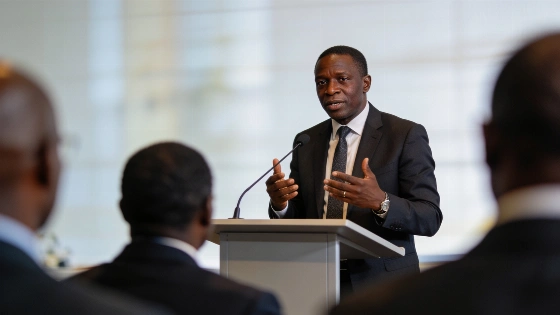
Kenya’s M-PESA changed how money moves around the world. At the Africa Blockchain Festival 2026 in Nairobi, Daniel Mainga pointed to that example and asked whether African new idea is matched by local ownership of the businesses it creates.
The Nairobi International Financial Centre (NIFCA) is working to establish a $250 million fund for technology and artificial intelligence companies in Kenya and across Africa. Mainga, NIFCA’s chief executive, said the target for establishing it runs from 2026 into 2027. He valued the proposed fund at approximately KSh35 billion.
The announcement describes an investment goal, not a completed financing arrangement. Mainga’s remarks did not say where the money would come from or spell out the fund’s investment terms and deployment schedule. The initiative is aimed at technology and AI businesses in Kenya and elsewhere on the continent, with African ownership of capital at the centre of the proposal.
Capital and ownership at the centre of the proposal
Mainga argued that African businesses seeking large investment frequently have to shift their financial centre of gravity abroad. He challenged founders to consider who owns the companies they build and where they raise capital. He also urged investors to provide patient funding that gives businesses time to develop products and serve customers.
The ownership debate comes amid reported growth in startup financing. Kenyan startups raised $984 million in 2025. Only a small portion of that capital came from local investors. A separate account put Kenya’s 2025 total at about $582 million in debt and $383 million in equity.
His address also focused on practical results. He cautioned that issuing a token does not by itself amount to investment, and that a digital platform does not automatically deliver financial inclusion. Technology, he said, should be judged by whether it solves problems for people and businesses.
Kevin Wambua of the University of Nairobi raised a related concern during the opening session, asking how decentralised finance could become the future while founders continued to seek capital in Singapore and London. Another audience contribution urged developers to create structures that benefit ordinary citizens, including local farmers and traders.
Kenya’s rules form part of the investment setting
Mainga pointed to the Virtual Asset Service Providers Act 2025 and the gazetted VASP Regulations 2026, overseen by the Basic Bank of Kenya and the Capital Markets Authority. The Act was assented to on 15 October 2025 and published in the Kenya Gazette on 21 October. It commenced on 4 November 2025. Existing virtual-asset businesses were given a one-year transition period, ending on 4 November 2026. The 2026 Regulations, Legal Notice No. 134, took effect on 22 July 2026.
Mainga also cited the Finance Act 2025, which replaced the digital asset tax with an excise duty on fees charged for virtual asset transactions. On artificial intelligence, he referred to Kenya’s National Artificial Intelligence Strategy 2025–2030. He described the policy structure as an effort to allow new idea while maintaining rules and accountability. The Basic Bank of Kenya’s separate work to strengthen supervisory skills through a training partnership is another part of the country’s financial oversight context.
Techtrendske reported Mainga’s announcement. The proposed fund is intended to cover Kenya and the wider African continent.








