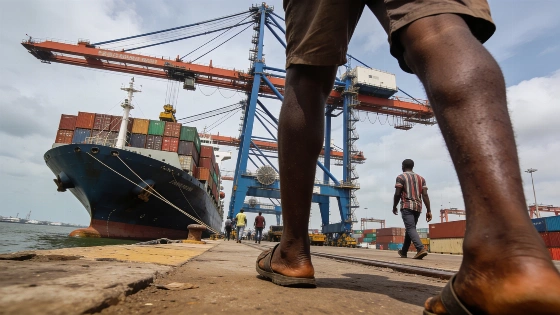
Because access at Nigeria's major ports is shallow, cargo bound for Nigeria is transhipped through Lomé in Togo and Tema in Ghana.
Construction is under way at Bakassi Deep Seaport in Cross River State. First conceived during the colonial era and re-engineered in 2014, the project's Environmental and Social Impact Assessment was completed in March 2015. Work then stalled for more than a decade, until Cross River formalised a public-private partnership in February 2025. Vice President Kashim Shettima represented President Bola Ahmed Tinubu at the groundbreaking ceremony in November 2026, marking the start of construction. Nigerian Ports Authority (NPA) CEO Abubakar Dantsoho said Nigeria needs to modernise its existing ports and develop deep-sea facilities. He described Apapa Port as approximately 100 years old. The Cross River State government's project account describes the development as part of an effort to expand the country's maritime capacity beyond Lagos.
Financing and port capacity
Bakassi is estimated to cost $3.5 billion, with Afreximbank identified as the project's principal financial institution, mandated lead arranger and financial adviser. An initial funding approval of $2.27 billion has been made under the PPP arrangement. The project value and initial approval are separate figures. The approvals and financing do not establish that the full project cost has been spent. Cross River Governor Bassey Otu formalised the PPP in February 2025, helping revive the long-delayed project. The Guardian reported that the proposed port is designed for a 20-metre draft, allowing it to accommodate large vessels that cannot access Nigeria's shallower existing ports.
The port is also linked to a planned 260-kilometre superhighway intended to provide an inland cargo route to markets across eastern, northern and western Nigeria. Afreximbank has identified roads, free-trade zones, customs infrastructure, energy and logistics systems as supporting infrastructure for the port. The project is intended to strengthen Nigeria's eastern maritime corridor and provide an alternative gateway to the country's existing concentration of port activity around Lagos.
Bakassi is one of five deep-sea ports approved by Nigeria's government. The others include Badagry Deep Water Port in Lagos State and Olokola Port in Ondo State. The list also includes Ibom Port in Akwa Ibom State and Bonny Port in Rivers State. A related Bakassi project report examined the proposed port's stated aim of easing congestion at Lagos ports.
Dantsoho said Nigeria needs to match economic growth with port modernisation. He called for work on existing brownfield ports alongside the development of greenfield deep-sea ports.
Ghana advances Keta and Takoradi plans
Ghana has shortlisted seven companies to bid for Keta port, proposed as the country's third commercial seaport. The firms are expected to help finalise design studies and propose a financing model. The government has not disclosed their names. Keta is intended to complement Tema and Takoradi.
Tema is Ghana's main import port, particularly for container shipping. Takoradi handles bulk exports including cocoa, as well as bauxite and manganese.
Construction has started on Berth 19 at Takoradi. The $98 million project is financed fully by the Ghana Ports and Harbours Authority (GPHA). The berth is planned to measure 300 metres and handle vessels of up to 75,000 dwt.