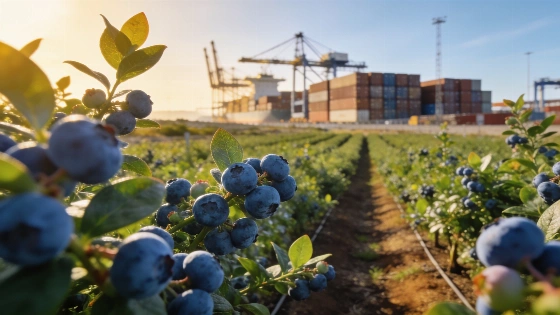
Wind-related disruption at South African shipping terminals remains the main operational constraint for blueberry exporters, who are working with container terminal operators to make cargo handling more efficient. At Cape Town Container Terminal, wind accounted for 905 of 1,326 closure hours between January and October 2026, or 68% of the total. October alone recorded 123 closure hours, including 82 attributed to wind, Freight News reported. Transnet National Ports Authority said it was assessing engineering and operational measures to reduce the effects of high winds on cargo handling.
The International Blueberry Organization reported that the season was on track to meet its initial forecasts through week 44. Another industry update said South Africa's 2026/27 season remained in line with export forecasts despite logistical disruption and weaker planned shipments to the Middle East. Brent Walsh, chief executive of Berries ZA, said production had started increasing earlier than usual, with supply moving from northern growing regions towards southern areas expected to provide most remaining export volumes. Tridge's season update also reported stronger demand from Europe and the United Kingdom.
Changing varieties lift orchard productivity
Planted area has remained relatively stable, while older blueberry varieties are being replaced with higher-performing genetics. Walsh said the shift had improved yields per hectare and fruit quality, with growers producing more from a similar area.
Weather conditions have varied by region. Walsh said the north experienced no material frost events, while intermittent short rain events in the south required careful timing of orchard work. Growers were managing those conditions to maximise output.
Market access and export destinations
Geopolitical instability in the Middle East has disrupted targeted shipments to the region. Demand from established European and UK markets has helped absorb the shortfall, according to Walsh, who said Berries ZA had supplied increased demand in both markets. The Tridge update similarly described stronger European and UK demand alongside disruption to planned Middle Eastern programs.
The association is also pursuing wider access in Asia to support longer-term growth and diversify export destinations. China had submitted a draft blueberry-import protocol for South Africa's consideration, and Agriculture Minister Willie Aucamp said on 19 November 2026 that negotiations were at an advanced stage. Aucamp signed a separate protocol opening China to South African cherries and called for faster coordination on the blueberry draft, with the stated goal of finalising it before the end of 2026. China-Africa SPS Cooperation reported that the blueberry protocol was still under negotiation.
India is also a target for market development, with access dependent on a phytosanitary protocol governing entry and plant-health requirements. Industry representatives cited the country's population of about 1.4 billion and its expanding middle class as reasons for pursuing the market. United Exports told ItalianBerry it was working to establish the protocol. Berries ZA has also taken part in access visits to Japan, Vietnam and South Korea.
Those efforts sit alongside other African attempts to simplify export processes, including Nigeria's planned shared platform for permits, covered in an earlier export report. Walsh said the Asian market-access work could create significant future growth opportunities.
Port congestion is also affecting other export routes. A separate backlog at Durban Gateway Terminal reportedly led to vessel waiting times of 14 to 20 days in November 2026. Transnet introduced emergency measures to clear the backlog, prioritising critical goods including medicine and agricultural cargo. Western Cape exporters warned that rerouting shipments through Ngqura in Gqeberha could add about R20,000 per shipment, according to reports by Maritime News and Daily News.