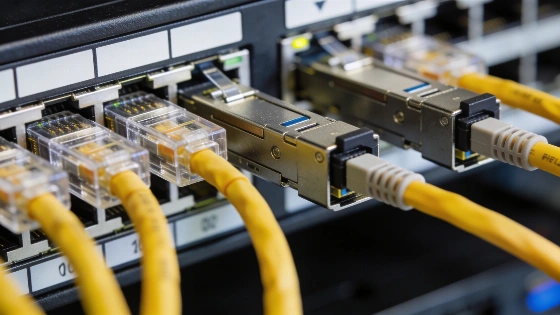
Optical transceivers convert electrical data into optical signals and carry data across fibre links inside data centres, putting a small component used in high-speed networks at the centre of a security and supply-chain dispute.
The Trump administration is moving ahead with proposed restrictions on imports of new Chinese optical transceiver models despite lobbying by Amazon, Google, Meta, Microsoft, Cisco and other technology companies. The Federal Communications Commission has pursued restrictions on national-security grounds. US officials have raised concerns about potential data theft and malware insertion, as well as possible service disruption. Reuters reported on November 17 that the administration was advancing the proposal, which could still be shelved if its position changes.
Chinese suppliers account for approximately two-thirds of the global optical-transceiver market. Amazon, Google, Meta, CoreWeave, Cisco and Microsoft reportedly discussed the issue with White House officials earlier in 2026, warning that US companies could need up to ten years to comply with a mandate. The proposal remains under consideration.
Telkom plans satellite distribution in South Africa
On November 17, Telkom Group announced an agreement under which its fibre-network subsidiary Openserve will act as an authorised distributor of Amazon Leo low-Earth-orbit satellite services in South Africa. The arrangement would extend connectivity to enterprises, eligible public-sector customers and small businesses beyond conventional fibre and wireless coverage. This distribution deal follows an earlier Amazon Leo distribution arrangement with South African provider Herotel.
Telkom said maximum configured speeds could reach up to 1 Gbps downstream and 400 Mbps upstream, depending on the selected enterprise plan and terminal; these are maximum figures, not guaranteed speeds for every customer. Commercial services are expected to launch in 2027. The agreement also follows a separate capacity testing report covering developments involving mobile networks and optical links. MyBroadband reported on the agreement.
AIS and Huawei open a Thai innovation centre
AIS and Huawei launched the AIS Agentic Transformation Joint Innovation Center in Thailand on November 16. The companies describe it as their first Autonomous Networks innovation centre outside China. It builds on collaboration that began in 2022 and aims to advance Level 4 autonomous-network capabilities. Their initiative focuses on AI-driven network automation and operations, including work toward commercial deployment. Capacity reported that the centre is intended to accelerate this work.
The work covers wireless, data communications, optical and core network domains. It includes single-domain autonomy and coordination between agents across network areas, with a focus on network maintenance, optimisation and operations. Level 4 autonomy involves highly autonomous, intent-driven operation using predictive analytics and AI-based closed-loop management; the autonomy scale runs from Level 0, or fully manual operations, to Level 5, or full autonomy. The companies said the centre will demonstrate operational improvements and a stronger user experience. They also cited network resilience and plans to support wider commercial deployment.