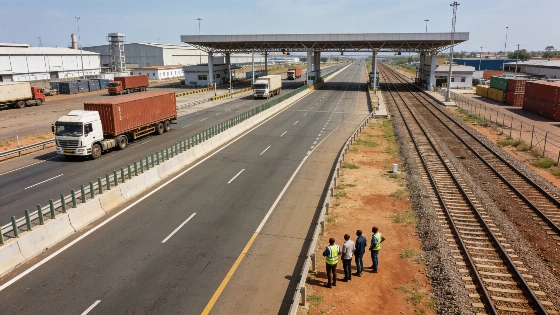
Across Africa, the future of the continent’s economy hangs on a simple question: can its sprawling network of transport corridors finally do more than just funnel raw minerals out to the world? The answer will shape whether Africa’s resources build local factories and regional trade, or if the old pattern of extraction and export keeps holding back real change.
In July 2026, the U.S. International Development Finance Corporation and the Development Bank of Southern Africa finalized a $753 million financing package to modernize 1,300 km of the Lobito Corridor railway, including upgrades to locomotives, wagons, and signaling systems.
Corridor ambitions run into real-world roadblocks
The Program for Infrastructure Development in Africa (PIDA) brings together the African Union, AUDA-NEPAD, and the African Development Bank. They have mapped out 42 priority corridors, and 25 already have AfDB funding. In all, 79 regional corridors are underway or planned. The goal is to cut the high costs and red tape that have long made it hard to move goods, people, and money across African borders.
But on the ground, progress is uneven. Weak coordination between countries, mismatched investments, and slow-moving governance keep tripping up projects. Too often, new infrastructure falls short of sparking the kind of economic activity it was supposed to unlock.
According to the World Bank, Africa's integration agenda now prioritizes the creation of cross-border value chains, reduction of trade and regulatory barriers, implementation of regional trade agreements, and the development of shared regional public goods such as transport corridors, energy markets, digital networks, and payment systems.
Who pays, who owns, and who gets the value?
African governments are not just watching from the sidelines. They put up more than 40 percent of active infrastructure funding, raising about $68 billion a year from their own sources. From 2014 to 2024, domestic capital pools topped $2 trillion, beating the total of all outside flows. The African Development Bank is the biggest institutional backer, with over $55 billion spent in the last decade. The Infrastructure Consortium for Africa, run by the AfDB, channels another $26 billion each year, with African countries themselves putting in 27 percent of that.
Outside money is still unpredictable. China, the top single-country lender outside the ICA, has shifted its focus to renewables, ports, and critical minerals, with $39 billion in commitments for 2025. To avoid the risks of debt and sudden shocks, African states are leaning more on pooled domestic funds and public-private partnerships, and moving away from expensive sovereign borrowing.
Recent deals show the scale of what’s at stake. In August 2026, the African Development Bank approved a $255 million loan and a $10 million grant for Zambia to join the Lobito Corridor project. This includes building about 550 km of new railway in Zambia. If more resources come in, total support could reach $500 million, according to a Zawya project update.
The thinking behind these corridors isn’t new. From the Lagos Plan of Action to Agenda 2063 and the African Continental Free Trade Agreement, the aim has always been to tie African economies together, lower trade costs, and keep more value from the continent’s own resources. The 2024 African Green Minerals Strategy now puts critical minerals at the center, making it clear that how corridors are built will decide if Africa keeps exporting raw materials or starts building up its own processing and manufacturing.
What works—and what doesn’t—in corridor development
Where things go right, the pattern is clear: integrated infrastructure, strong institutions, and a mix of funding sources. The Abidjan–Lagos Corridor, managed by an independent ECOWAS board and backed by private investors, shows how coordinated oversight can turn a corridor into a backbone for the economy. On the other hand, projects with scattered governance or a single dominant investor often end up with unsustainable debt and little benefit for locals.
Building a port or a railway by itself rarely changes much. Corridors only drive real growth when ports, roads, rail, energy, and industrial zones work together as one system, backed by clear laws, rules, and security. The takeaway: African control, smart planning, and strong institutions are essential if corridors are going to move past extraction and deliver real value on the ground.
Now, as African governments and institutions tackle the next wave of corridor projects, the stakes are plain. The continent’s mineral wealth and domestic capital are proven. What matters now is whether leaders can coordinate, fund, and manage these corridors as unified systems that serve African interests—not just outside ones.