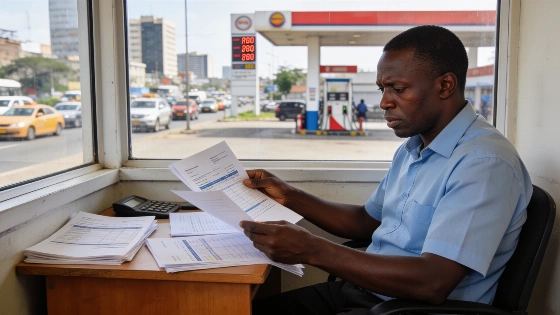
Fuel, transport, and food prices keep climbing. Kenyan businesses are feeling the squeeze. Many have no choice but to raise prices. The pressure is building fast.
Core inflation, which excludes volatile food and fuel prices, accelerated to 4.0% in September from 3.4% in August, indicating that price pressures are spreading beyond just food and energy.
Cost pressures and sector gaps
About 30 percent of firms surveyed in September said their input costs went up. Only 1 percent saw any drop. The Kenya National Bureau of Statistics reports annual inflation hit 6.8% in September 2026, up from 6.6% in August. The consumer price index rose 0.4% in a month, from 155.85 to 156.47. Food and non-alcoholic drinks jumped 9.5 percent year-on-year. Transport costs shot up 15.6 percent. Petrol and diesel prices in Nairobi stayed high, capped at about 1.66 and 1.69 US dollars per litre for the September 15 to October 14 period. In September, a litre of petrol averaged 214.95 Kenyan shillings, up 15.8% from last year. Diesel hit 219.04 shillings per litre, a 26.9% jump. Households and businesses are feeling the pinch. The Kenya National Bureau of Statistics report spells it out.
Not all sectors are moving together. Manufacturing, construction, and services are growing. Agriculture, wholesale, and retail are still struggling. The numbers show the split. In the first quarter of 2026, real GDP grew 5.3 percent. Manufacturing rose 4.4 percent. Construction climbed 6.6 percent. Accommodation and food services soared 14.7 percent. Agriculture grew 4.9 percent but still faces big hurdles. It gets just 3.5 percent of all bank loans, even though it makes up about 23 percent of GDP. That’s a big gap.
Fuel prices didn’t change between August and September. But the yearly rise in petrol and diesel has pushed up costs for manufacturers, transporters, and retailers. Electricity gave some relief. The average cost for 50 kWh dropped from 1,289.47 to 1,258.21 Kenyan shillings in a month. That helped offset some of the pain. Details are in a Business Today analysis.
Despite stable retail fuel prices from September 15 to October 14, the import cost of diesel jumped 11.86% to $957.05 per cubic meter, and kerosene rose 9.71% to $1,003.87, signaling continued vulnerability to global oil price shocks.
Monetary policy and credit trends
The Central Bank of Kenya has cut rates ten times since mid-2024. The policy rate dropped from 13.00 percent to 8.75 percent by February 2026. This made it easier for businesses to borrow. Lending rates fell from 17.2 percent to about 14.3 percent. Private sector credit growth turned around—from a 2.9 percent drop in January 2025 to 10.2 percent growth by July 2026. Banks now have more cash to lend. Private sector lending is at a record high.
Purchasing activity grew for the first time in five months. Hiring kept up with the extra work. Outstanding business has risen for four months. Firms are taking on more than they can finish. But high borrowing costs and weak household finances are still a drag. The share of adults who can meet daily needs, handle shocks, and invest has dropped. In 2016, it was about 36 percent. By 2026, it’s just 18.3 percent, says FSD Kenya. Non-performing loans are stuck at around 15.5 percent. Agriculture, trade, manufacturing, and consumer lending are hit hardest. The burden is heavy.
Risks and the road ahead
Stanbic Bank says the recovery is driven by demand, not broad growth. If costs and supply problems don’t ease, higher demand could just mean higher prices. Output may not rise. The World Bank has already cut Kenya’s 2026 growth forecast to 4.3 percent. The reason: higher global energy prices and more uncertainty. The African Development Bank expects 4.6 percent growth but warns about climate shocks, energy price swings, and political risks before the 2027 elections.
Kenya’s private sector is on edge. Credit and demand are better, but the recovery is fragile. Inflation, supply snags, and sector gaps threaten progress. If cost drivers aren’t tackled and credit doesn’t reach agriculture and weak sectors, the rebound could stall. The next phase depends on more than just lower rates. Kenya needs to break down the barriers holding back its key industries. The clock is ticking.