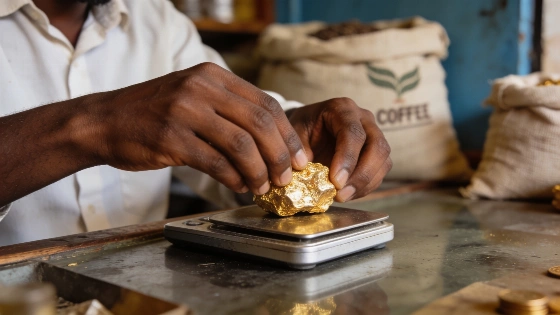
Foreign-exchange and gold-marketing reforms introduced in July 2024 helped make official gold sales more attractive than informal channels. A market-based exchange rate and changes to National Bank of Ethiopia gold purchase prices shifted incentives for sellers.
In the first two months of the 2026/27 fiscal year, gold brought in $1.344 billion, nearly 18 times the revenue generated by the entire manufacturing sector. Coffee added $605.85 million. Together, the two commodities accounted for 84.4% of Ethiopia’s $2.309 billion in export receipts.
Manufacturing exports earned $74.91 million, or 3% of the total.
Total receipts rose 176% from $836.66 million in the same period a year earlier. They topped the government’s two-month target of $2.224 billion by $85.01 million, or 3.82%.
Gold drives the export surge
Mining generated $1.346 billion, exceeding its target by 20.23%. Gold accounted for virtually all of the sector’s income. IMF programme materials say the central bank spent about 350 billion birr buying gold in 2025/26, more than twice the previous year’s amount. The National Bank remains Ethiopia’s sole authorized gold exporter.
Ethiopia’s Ministry of Mines reported production of about 44 tonnes of gold in 2025/26, the fiscal year ending in July 2026. The country also recorded export earnings of roughly $5.65 billion that year. Gold made up about half of estimated total export receipts of $11 billion. The Ethiopian News Agency reported that gold export earnings were about $408 million in 2023/24.
The International Monetary Fund linked stronger recorded gold exports to formalisation and higher international prices. It also cited increased volumes. Officially recorded exports rose from slightly more than four metric tonnes in 2023/24 to nearly 39 tonnes in 2024/25, according to the Fund. The IMF cautioned that some of the increase came from accumulated inventories rather than new production. Its programme review projected gold export volumes of about 30 tonnes in 2025/26, down from 39 tonnes the year before. The Ministry of Mines’ figure of 44 tonnes refers to production, not exports. The IMF review materials also tied the rise in official exports to market reforms and the shift of more gold into legal trading channels.
That distinction matters. Moving existing supplies into official channels can raise recorded exports without a matching increase in mining output. Central bank gold purchases have supported foreign-exchange accumulation. The IMF’s July 2026 programme review also cited higher gold exports as a factor behind improvements in Ethiopia’s external position.
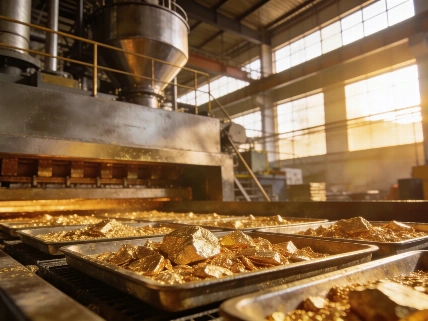
In October 2026, Ethiopia opened its National Precious Metals Refinery in the Bole Lemi special economic zone. The facility is intended to process gold domestically. Its announced capacity is more than 600 tonnes of precious metals a year at full operation, including material that could come from other countries. That figure is not directly comparable with Ethiopia’s gold export volume. The state media report describes the refinery’s intended role in processing and certifying metals for Ethiopia and the wider African market.
Coffee supports agriculture as factories lag
Agriculture earned $837.99 million, with coffee responsible for most of the sector’s receipts. Shipments of about 90,300 tonnes generated $605.85 million amid elevated international prices. Expanded market access and changes to domestic trading arrangements also supported coffee exports.
Other agricultural exports included $130.83 million from live animals and $60.77 million from pulses. Floriculture reached 96.63% of its revenue target. Fruit and vegetable exports exceeded their target by 6.68%. The sector shipped 112.57% of its planned volume.
Manufacturing reached only 62.75% of its $119.38 million earnings target. Its 18,773 tonnes of shipments amounted to 43.70% of planned volume. Basic metals and engineering products earned $10.73 million, just 24.92% of target. Exports in food and beverage, along with pharmaceuticals, brought in $15.17 million, or 60.83% of target.
Some subsectors beat their targets. Leather and leather products earned $6.35 million, 19.63% above plan. Meat and dairy exports brought in $20.35 million, exceeding target by 6.69%. Manufacturers also face higher birr costs for imported machinery and intermediate goods following exchange-rate depreciation. Financing remains a constraint. Logistics and production costs add to the pressure.
Strong receipts do not erase external risks
Electricity exports generated $50.07 million, 24.30% above target, and accounted for about 2.2% of total receipts. Ethiopia sells power to neighbouring countries, including Djibouti and Kenya. It also exports electricity to Sudan. The Grand Ethiopian Renaissance Dam has added to the country’s potential for regional electricity trade.
The first two months brought in about 22.6% of the government’s $10.2 billion full-year export target. Seasonal production and shipping schedules make that early performance an uncertain guide to the full year. Commodity prices add another variable. Higher export receipts also do not automatically close the trade gap: the IMF projected a merchandise trade deficit of about $12.6 billion for 2025/26, with imports continuing to weigh on external accounts.
Gold and coffee concentration leaves export earnings exposed to price movements. In its July 2026 assessment, the IMF warned that lower prices for either commodity could put pressure on international reserves. The figures come as households face domestic strains described in an analysis of household pressures. Under the reform programme, the National Bank of Ethiopia is expected to develop a longer-term strategy to reduce its direct role in gold purchases and gradually eliminate premiums paid above international prices.