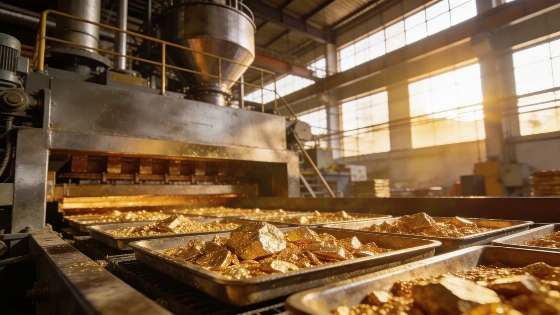
Gold's value is largely realised before refining, leaving operators with a narrow commercial case: they need scale and access to major bullion markets to make the business work. That constraint is drawing sharper scrutiny to West Africa's refinery expansion.
At least four major refineries launched or commissioned by governments in the region since 2024 have combined annual capacity of more than 1,000 metric tons. Estimated regional output is about 585 tons, making announced capacity roughly 1.7 times estimated mine production. Miners and investors warn that plants could compete for a limited supply of gold that is accessible and responsibly sourced. If refineries cannot secure enough feedstock, investors and governments could see weaker returns, as Reuters reported.
Capacity and market access
"There is already overcapacity in terms of gold refining across Africa and globally," Rand Refinery chief executive Dean Subramanian told Reuters. "The risk is additional processing capacity competing for the same accessible, responsibly sourced feedstock."
Ghana, Africa's largest gold producer, plans a new refinery with annual capacity of 600 tons in 2027, despite having several underutilised refineries. Dan Krampah, chief executive of the Ghana Chamber of Bullion Traders, said there was no "economically compelling case for another refinery", Reuters reported.
Commercial viability also depends on accreditation. London Bullion Market Association (LBMA) Good Delivery status gives refiners access to major bullion-trading networks and is often required to sell to major banks, traders and central banks. Applicants must show annual refined-gold production of at least 10 tons. They also need tangible equity equivalent to £15 million and an established operating record. Without Good Delivery status, producers may need to sell through intermediaries or face more limited access to key institutional buyers.
Domestic goals and unresolved terms
Governments defend local refining as part of wider economic and strategic plans. Supporters say it could help formalise artisanal mining and give central banks greater access to domestic gold. Ghana's domestic gold-purchasing programme is also linked to foreign-exchange reserves. In 2025, the Bank of Ghana purchased and exported about 104 tons of artisanal and small-scale mining gold for $10.9 billion, representing essentially all reported domestic output from that segment, according to the IMF's Ghana report. The report also records $1.26 billion in gold bullion purchases, equivalent to about 12% of large-scale miners' output. Ghana plans to double its recent large-scale gold purchases, targeting an amount equivalent to 30% of total output.
The Bank of Ghana's plan applies a 0.55% discount relative to international prices and calls for gold to be refined domestically before validation at an LBMA-certified South African refinery. Gold bought by the central bank has historically been refined abroad in LBMA-certified facilities, mostly in Europe. The plan pairs domestic processing ambitions with continued reliance on internationally recognized refining and validation. The regional reach of financial institutions has also featured in coverage of Kenyan banks, though that story concerns banking assets rather than bullion markets.
Appian Capital Advisory CEO Michael Scherb called governments' push for local processing "a noble goal", but warned that many countries lack the power and infrastructure to support it at scale. He also cited shortages of skills and capital.
In Guinea, miners are stockpiling gold as they adjust to new local refining requirements. Three executives said refining fees and settlement terms remain unclear. Marketing arrangements are also unresolved, fuelling concern that locally refined gold could sell at a discount.
Guinea's Mines Minister Bouna Sylla said the country aims to build a broader domestic gold ecosystem centred on traceability and central-bank reserves, with Dubai as the region's dominant gold market. "We need to make Guinea competitive and create a transparent system that can attract business," he told Reuters.