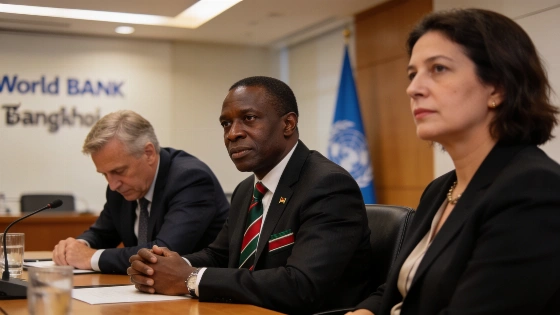
Kenya faces about KSh1.7 trillion in debt repayments by June 2027, a heavy refinancing burden as Treasury Cabinet Secretary John Mbadi met senior World Bank officials in Bangkok, Thailand.
The talks took place during the IMF and World Bank Group annual meetings, held from October 12 to 18. Kenya discussed financing and economic growth, with fiscal sustainability and public debt management also on the agenda. Officials reviewed plans to bring in projects for the coming financial year.
The Treasury said the meeting covered risks to Kenya’s economy and prospects for private-sector investment. Mbadi was accompanied by Treasury Principal Secretary Dr Chris Kiptoo. Central Bank of Kenya Governor Dr Kamau Thugge also attended. The engagement comes as talks on a new IMF lending agreement have slowed and borrowing costs remain high. The government is trying to narrow the budget gap while protecting development spending and refinancing maturing obligations, Tuko News reported.
Mbadi outlined Kenya’s economic prospects and reaffirmed the government’s commitment to fiscal consolidation. He also backed prudent debt management and structural reforms. Fiscal consolidation means narrowing the gap between government revenue and spending. Debt management aims to keep borrowing and repayment obligations sustainable.
By June 2027, Kenya is due to repay about KSh1.7 trillion ($13.1 billion), roughly 12.7% of a total debt portfolio estimated at KSh13.2 trillion ($102 billion). About KSh1.06 trillion of the repayments is principal. The rest consists of related payments and debt-service costs. The schedule leaves the Treasury reliant on domestic and external refinancing, along with efforts to raise revenue. Reuters reported that public debt stood at KSh13.01 trillion ($100.85 billion) at the end of June 2026, up from KSh11.81 trillion ($91.55 billion) a year earlier. Domestic debt was KSh7.32 trillion; external debt was KSh5.68 trillion.
The Treasury said its measures are intended to support stability and long-term growth. The World Bank raised its 2026 growth forecast for Kenya to 4.6%. The National Treasury, meanwhile, cut its own projection from 5.3% to 5%. The World Bank projected average inflation of 5.5% and a budget deficit of 6.1% of GDP. It put public debt at 71.1% of GDP.
IMF discussions have been delayed. In March 2026, Mbadi said a subsequent IMF visit was not expected to produce an immediate lending agreement automatically. Kenya and the United States also discussed preparations for IMF Article IV consultations expected in Nairobi in December. They covered publication of a Governance Diagnostic Report, as Capital FM reported.
The World Bank meeting also covered domestic and global economic risks, private investment, and implementation of World Bank-supported programmes. One agenda item was onboarding projects for FY 2026/27. The Treasury’s statement did not name the projects.
The push for private investment fits Nairobi’s wider role in regional finance, examined in Nairobi’s capital-market shift. The Treasury said business investment can support jobs and economic activity. It can also increase public revenue. Kenya is seeking to reduce its deficit while maintaining spending on infrastructure and social services, as high debt-service costs sharpen the need to choose development projects carefully.
The Treasury announced the meeting in a statement posted on X on Tuesday, October 13, 2026. Mbadi met World Bank Regional Vice President for Eastern and Southern Africa Dr Ndiamé Diop to review Kenya’s outlook and development priorities. Dr Kiptoo and Dr Thugge also took part. On October 12, Mbadi met Eric Meyer, the US Treasury Department’s Deputy Assistant Secretary for Africa and the Middle East, in Bangkok.