Moroccan ports handled 261 million tons of cargo in 2025, while combined capacity stood at 300 million tons. The country is targeting capacity of 390 million tons and annual cargo traffic of 300 million tons by 2030.
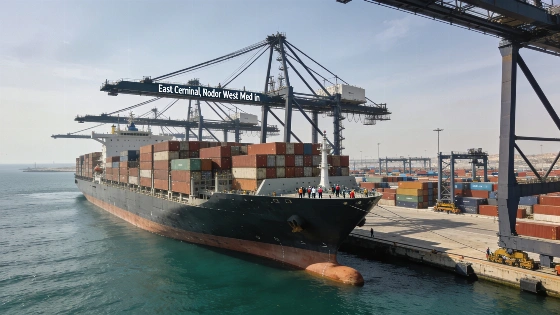
On 31 October 2026, Crown Prince Moulay El Hassan launched operations at Nador West Med's East Terminal in the commune of Iaâzzanène, Nador province, acting on instructions from King Mohammed VI. The opening marks the start of a phased expansion of port capacity. The Ministry of Equipment and Water said the wider port and industrial complex is backed by 54 billion dirhams (US$5.5 billion) in public and private investment: 31 billion dirhams in public funding and 23 billion dirhams in private investment. The terminal launch announcement described the East Terminal as the first operational phase of the wider complex.
Container capacity and port competition
The East Terminal represents about 5 billion dirhams (US$510 million) of investment. Its quay extends 1,520 metres, while its draft is 18 metres. The facility has 70 hectares of container yards. Annual capacity is expected to reach 3.5 million containers by 2030; the operator-stated figure has also been reported as 3.4 million TEUs. The terminal's reported specifications include the quay, draft and yard area. Marsa Maroc and Terminal Investment Limited, a subsidiary of MSC Group, hold a 25-year concession covering operations and maintenance.
Nador West Med's ability to capture transhipment cargo will depend on attracting shipping operators. Efficient inland connections and economic activity around the complex will also matter. Competition includes Tanger Med, which handled 11.1 million TEUs in 2025. Algeria's Djendjen is another competitor, alongside Spain's Valencia and Algeciras.
The importance of cargo capture is illustrated by Nigeria's refinery-linked port traffic, reported as 30.4% of national port throughput.
Further terminals and energy infrastructure
A second container terminal is planned for the western side of the complex and is expected to enter service in April 2027, adding projected annual capacity of 1.8 million TEUs. The two terminals are planned to provide combined capacity of 5.3 million TEUs. Marsa Maroc is expected to operate the western terminal in partnership with French shipping group CMA CGM. The roll-on/roll-off terminal, designed for 400,000 units and with 380 metres of quay, was completed in September 2026.
Other cargo facilities remain at different stages. A bulk terminal with capacity of 7 million tons is expected in June 2027. A 22-hectare general cargo terminal, designed to process 3 million tons annually, is scheduled to open in December 2028.
Energy plans include an LNG terminal with capacity of 5 billion cubic metres. A petroleum products terminal designed to handle 25 million tons, with three 125-metre berths, is scheduled to begin operations in April 2027. Morocco imports most of its refined petroleum products; the dedicated facility would reduce reliance on Tanger Med and Mohammedia for fuel imports while supporting industrial activity in the Oriental region. Nador West Med is being developed as an industrial-port and logistics complex on Morocco's northeastern Mediterranean coast, with container facilities and other infrastructure planned.